
The internet loves a list of habits to quit, and the eight that circulate most in India are packaged food, sugar, maida, refined oil, too much salt, late dinners, drinking water right after meals and staying up late. Most of that list holds up. A few items are stretched further than the evidence goes, and one is mostly a myth. The promise attached to it, “quit these eight and your body will heal itself”, is the weakest part of all.
I went through each of the habits to quit against the actual research and against India’s own 2024 dietary guidelines from ICMR-NIN. Below you’ll find what’s solid, what’s exaggerated, what to do instead, and a realistic order for making the changes without burning out by day three. That last part matters. People rarely fail because they didn’t know which habits to quit. They fail because they tried to quit all of it on Monday.
General information only. If you take medicines for diabetes or blood pressure, talk to your doctor before changing meal timing, salt or sugar, because doses sometimes need adjusting.
The scorecard: eight habits to quit, graded
Here’s the verdict on the habits to quit before the detail, so you know where I’m headed.
| Habit | Is it worth quitting? | How good is the evidence? | The catch |
|---|---|---|---|
| Packaged and ultra-processed food | Yes | Strong, including a randomised trial | “Designed to keep you hungry” is a stretch; not all packaged food is the problem |
| Sugar | Yes, mostly sugary drinks | Strong | You don’t need to avoid whole fruit |
| Maida (refined flour) | Yes, cut down | Moderate to strong | Whole-wheat atta isn’t a magic fix either |
| Refined oil | Partly | Mixed | Trans-fat fears are overstated; cold-pressed and ghee aren’t proven better |
| Excess salt | Yes | Strong | Sendha and kala namak aren’t better; iodine matters |
| Late dinner | Yes, within reason | Moderate | The key study is small |
| Water right after meals | Not really | Very thin | Mostly a myth |
| Late nights | Yes | Strong | Consistency matters as much as hours |
1. Packaged and ultra-processed food: the first of the habits to quit
Chips, biscuits, namkeen, cold drinks, instant noodles, and a lot of what’s sold as “healthy” (protein bars, ready-to-eat snacks): this is the group researchers call ultra-processed food, or UPF.
The best evidence is a 2019 trial by Kevin Hall at the US National Institutes of Health. Twenty adults lived in a research ward for four weeks, two weeks on an ultra-processed diet and two on a minimally processed one, in random order. The meals were matched for calories offered, sugar, fat, salt and fibre. People could eat as much as they liked. On the ultra-processed diet they ate about 500 more calories a day and gained roughly 0.9 kg in two weeks, while on the minimally processed diet they lost about the same. They also ate faster on the ultra-processed diet.
That’s a small trial, short, run in a hospital ward. But it’s one of the few that isolates the food itself, not just the nutrients on the label, and it fits the larger observational literature linking UPF with weight gain and chronic disease.
Now the part that gets exaggerated. The claim that these foods are “designed to keep you hungry” makes it sound like a conspiracy. The more accurate version is that they’re engineered to be hyper-palatable and easy to eat quickly: soft, energy-dense, low in fibre, and often water-removed, so you take in more calories before your fullness signals catch up. You’ll also hear that the brain needs exactly 20 minutes to register fullness. That number is a popular rule of thumb, not a precise measurement, but the broader point that eating fast leads to eating more has support.
Two honest caveats about these habits to quit. First, “packaged” doesn’t automatically mean ultra-processed. Plain curd in a packet, packed atta, dal, frozen peas and milk are all packaged and perfectly good. The category that matters is the one with long ingredient lists, flavourings and additives. Second, the idea that quitting makes you crave more for a week isn’t something I found studied. Expect a transition period, but don’t take the timeline as fact.
ICMR-NIN’s 2024 guidelines say to minimise ultra-processed foods and note that adding nutrients to them doesn’t make them healthy. The same guidelines caution about protein powders for building muscle and about “sugar-free” labels. If you’re weighing that against our own take, our guides to protein powder for women and functional protein and next-gen collagen go through when those products make sense and when they don’t.
What to do instead: with habits to quit like this one, don’t try to ban everything. Replace the daily ones first: the biscuit with tea, the 4 p.m. packet, the cold drink with lunch. Keep a few home-made snacks ready (roasted chana, fruit, curd, nuts). In the US trial, the unprocessed diet cost more per week, but in much of India, dal, roti, sabzi and fruit are the cheaper meal, and the packet is the premium purchase.
2. Sugar, among the habits to quit
The case against sugar rests mostly on sugary drinks and added sugar, and it’s strong. WHO advises keeping free sugars below 10% of daily energy, and below 5% for added benefit. ICMR-NIN’s 2024 guidelines say sugar should be under 5% of energy, and the institute’s director has said that if you do eat sugar, try to stay near 30 grams a day.
The liver story is real, though simplified. Table sugar is half glucose and half fructose. Most of your body’s cells can use glucose. Fructose is handled mainly by the liver, and large, fast doses, like the ones in cold drinks or packaged fruit juice, can push the liver to turn the excess into fat. Over years, that fat can build up (fatty liver, now called MASLD) and make the liver less responsive to insulin, which drives the pancreas to make more of it, and that’s one road to type 2 diabetes. Randomised trials, including a six-month Danish study in overweight adults, have found liver fat rising in people drinking regular cola but not in those drinking milk, diet cola or water. Short trials in children and adults have also shown that cutting fructose-sweetened drinks lowers liver fat and triglycerides within weeks.
What’s overstated: the idea that sugar “directly destroys” the liver on its own. Excess calories and weight gain matter too, and the harm depends on how much and in what form. And please don’t read this as “avoid fruit”. Whole fruit comes with fibre and water, and the evidence doesn’t link it to fatty liver in the same way. Packaged juice is a different story, since it’s basically fructose with the fibre stripped out. Jaggery, honey and brown sugar still count as free sugar. Artificial sweeteners aren’t a clean exit either: ICMR-NIN specifically warns about long-term use, so treat them as a bridge, not a lifestyle.
The timelines you’ll hear (less afternoon slump in a week, triglycerides dropping in three to four weeks, liver fat improving in two to three months) are plausible, and they come from short trials, not guarantees. Your results will vary.
What to do instead: of all the habits to quit, this one is easiest at the liquid end: cut the liquid sugar first. Swap cold drinks and packaged juice for water, nimbu pani without sugar, chaas or plain tea. Then reduce sugar in chai gradually. Mithai at festivals is fine. A daily habit is what hurts. If you’re curious how your own body responds, our blood sugar and insulin resistance pages are a good start, and our piece on CGM for non-diabetics covers whether tracking is worth it.
3. Maida, one of the habits to quit gradually
Maida is wheat that’s been refined to white flour, with the bran and germ, and so most of the fibre and many micronutrients, removed. That’s the basic criticism, and it’s accurate. Without fibre, starch is digested and absorbed faster, which raises blood sugar quickly, and then insulin follows, sometimes producing a dip and a return of hunger a couple of hours later. A bajra or jowar roti, higher in fibre and digested more slowly, usually keeps people full for longer.
The long-term argument is that years of these sharp rises can contribute to insulin resistance, the stage before type 2 diabetes. That’s supported in broad strokes: pooled cohort studies tend to link more whole grains with lower diabetes risk and more refined grains with higher risk. But it’s a pattern across large groups, not a guarantee for any individual, and it depends on the rest of your diet.
Two nuances the short version skips. Whole-wheat atta isn’t magic. A whole-wheat roti has more fibre than a maida naan, but it still raises blood sugar meaningfully, and the amount you eat matters. ICMR-NIN’s 2024 guidelines suggest no more than 45% of calories should come from cereals and millets, with pulses, beans and meat contributing up to 15%. That means more dal, vegetables and protein alongside your roti, not a different roti on its own. Millets help, but they’re not miracle foods either, and variety is the point.
The constipation claim is plausible and practical. Low-fibre diets are a common cause. If constipation is your problem, you’ll find the same fibre advice, including isabgol, in our guide to home remedies for piles, and more on digestion in our gut health pages.
What to do instead: treat maida as one of the habits to quit gradually: swap the biggest sources first (white bread, bakery items, naan, noodles, pasta), then work towards whole grains and millets over time. Pair any carb with dal, curd, vegetables or protein, which slows the rise. You don’t need to eliminate maida for life. You need it to stop being your default.
4. Refined oil: the half-true entry among habits to quit
This is the claim among the habits to quit that I’d handle most carefully, because it’s half true.
What’s accurate. Most commercial refined oils are made by extracting oil from seeds, often with a solvent like hexane, followed by degumming, bleaching and a high-heat deodorising step. That strips colour, smell and taste, and it removes some natural antioxidants such as vitamin E. A small amount of trans fat can form during the high-heat step. Reheating oil repeatedly for frying creates more harmful compounds.
What’s exaggerated. The amount of trans fat produced in refining is typically small, generally in the low single digits as a percentage of the oil. India’s food regulator, FSSAI, has capped industrial trans fat at 2% of oils and fats since 2022, and WHO’s guidance is to keep trans fat below 1% of total energy. The statement that “any amount is unsafe” is built on the logic that industrial trans fat has no safe level, which is a reason to avoid foods like vanaspati-based bakery products and fried street snacks, but it makes trace amounts in a tablespoon of oil sound far worse than the real exposure. Hexane residue in finished oil is generally negligible.
What’s unproven. The idea that cold-pressed oil or desi ghee is clearly better. I couldn’t find a head-to-head trial showing better outcomes for people who switch from refined oil to cold-pressed oil. Cold-pressed oils retain more antioxidants and flavour, which is a point in their favour, but oils from seeds rich in polyunsaturated fat still oxidise when heated. And ghee is mostly saturated fat. It’s fine in small amounts, but the claim that it’s heart-friendly isn’t settled, and ICMR-NIN advises keeping total fat to 30% or less of energy.
What matters more than the type: how much you use, how often you deep-fry, and whether you reuse oil. Rotating different oils, using less, avoiding reused frying oil and cutting packaged fried snacks probably does more than switching brands.
What to do instead: among the habits to quit, this one is about quantity: measure oil with a spoon instead of pouring it, shift from deep-frying to sautéing, steaming and roasting, never reuse frying oil repeatedly, and vary your oils. If you prefer cold-pressed or ghee for taste, use them sparingly.
5. Too much salt: the best-evidenced of the habits to quit
This one of the habits to quit is well-founded, and India’s numbers are striking. WHO recommends under 5 grams of salt a day, a bit under one teaspoon. ICMR-NIN’s guidelines match that. Estimates of what Indians actually eat vary: an ICMR survey reported an average around 8 grams a day, with men higher than women, a 2017 systematic review in the Journal of Hypertension put the average near 11 grams, and ICMR’s National Institute of Epidemiology has said about 11 grams, more than twice the limit. The studies agree on the direction even if the exact number is uncertain: Indians eat well over the limit.
The mechanism is simple: more sodium means more water retained, more blood volume and higher pressure on the artery walls, raising the risk of hypertension, stroke, heart disease and kidney disease.
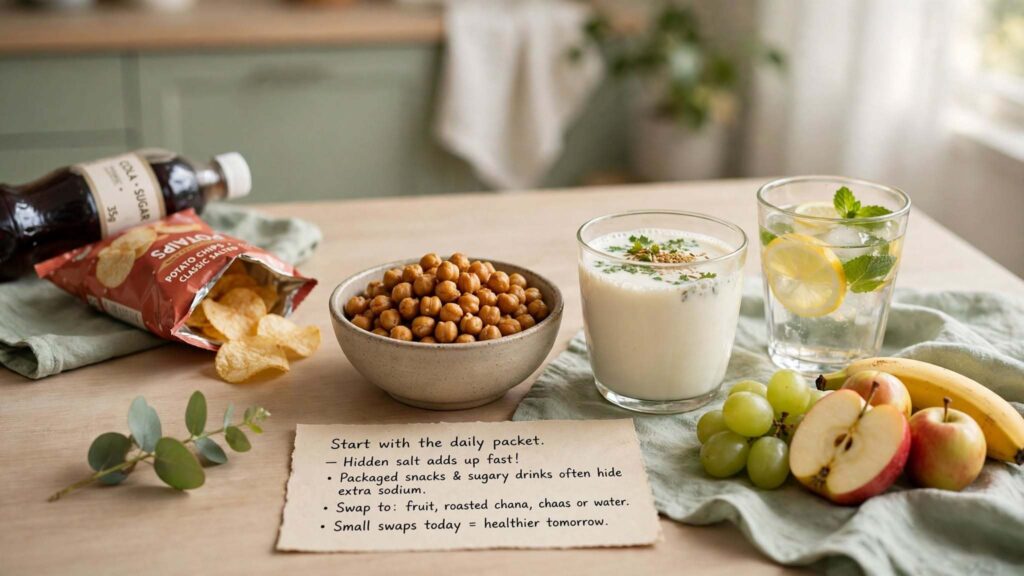
The “hidden salt” point is fair. ICMR’s epidemiologists point to pickles, papad, namkeen, biscuits, bread, vada pav, chips, instant noodles and other packaged food as major hidden sources. Salt added in home cooking and at the table matters too, so cutting only the packet or only the spoon won’t be enough.
The sendha and kala namak myth is correct to bust. ICMR-NIN’s 2024 guidelines explicitly say there’s no meaningful difference in sodium content among sea salt, black salt, rock salt and Himalayan salt. They’re all mostly sodium chloride. One addition the short version misses: iodised table salt is how most Indians get iodine. Switching entirely to rock salt can leave you short unless you get iodine elsewhere, which matters especially in pregnancy and for children.
There is one genuinely useful tool: low-sodium salt, where some of the sodium is replaced with potassium. A large trial in rural China (the SSaSS study) found fewer strokes with salt substitutes, and ICMR scientists say switching to low-sodium salt can lower blood pressure by an average of about 7/4 mmHg. It’s not suitable for people with kidney disease or on potassium-restricted diets, and it isn’t available everywhere. In ICMR’s survey it was stocked in only a minority of shops and cost over twice as much as ordinary iodised salt. If you have high blood pressure, ask your doctor.
What to do instead: of the habits to quit, salt rewards patience: cut the packet foods first, since they carry the hidden salt. Reduce the salt in cooking gradually so your taste adjusts (many people find it does within a few weeks). Use lemon, ginger, garlic, herbs and roasted spices for flavour. Read labels: sodium on the label × 2.5 gives you the salt equivalent. And don’t add extra salt at the table by habit.
6. Late dinner: one of the habits to quit, within reason
There’s a real study behind this one of the habits to quit, and it’s more interesting than the usual advice. Researchers at Brigham and Women’s Hospital in Boston (a Harvard-affiliated hospital) had 16 people with overweight or obesity complete two six-day protocols. In one they ate at 8 a.m., noon and 4 p.m.; in the other, the same meals four hours later (noon, 4 p.m. and 8 p.m.). Everything else was kept the same. When they ate later, the odds of feeling hungry roughly doubled, the ratio of the hunger hormone ghrelin to the fullness hormone leptin rose by about a third, they burned around 5% fewer calories, and gene activity in fat tissue shifted toward storing fat.
It’s a small, tightly controlled study, with only five women, and the “late” dinner was at 8 p.m., not midnight. It also shows an association with mechanism, not proof that late dinners cause obesity in the real world. Still, it fits earlier observational work.
The melatonin explanation you’ll hear, that night-time melatonin reduces insulin release so food eaten late is handled worse, has some support: glucose tolerance is poorer at night in several studies, and the effect looks stronger in people with particular genetic variants. I wouldn’t state it as a simple universal rule. And the “body repairs itself at night so digesting interferes” idea is more of a theory than a finding.
There’s a practical, uncontroversial reason to finish dinner earlier, too: lying down soon after a large meal makes reflux more likely, which is why the advice for heartburn is to finish eating two to three hours before bed. Our guide to acid reflux and GERD covers that, and our piece on circadian fasting and time-restricted eating looks at the wider timing research.
A real safety point: if you take insulin or diabetes tablets, don’t change dinner time on your own. Eating earlier or skipping a late snack can cause low blood sugar. Ask your doctor first.
What to do instead: for this one of the habits to quit, aim to finish dinner two to three hours before sleep, and make dinner the lighter meal. If work or commute makes early dinner impossible, shift the weight to lunch and keep late meals small and simple. You don’t need to eat before sunset to benefit.
7. Drinking water right after meals: the weakest of the habits to quit
I’ll be blunt: this is the weakest of the eight habits to quit. The claim is that a glass of water straight after eating raises pressure in the stomach, opens the valve at the top, and causes acid reflux, so you should wait 40 to 60 minutes. I searched for trials supporting a delay and couldn’t find any. The idea comes largely from traditional Ayurvedic advice and has been repeated widely since.
Here’s what we do know. Reflux happens when the valve between the oesophagus and stomach relaxes or is overpowered, and the usual triggers are large meals, lying down soon after eating, extra weight, smoking and certain foods. Gulping a big volume of fluid or a fizzy drink might aggravate it in some people, so it’s reasonable if you get reflux to sip rather than chug. But the major gastroenterology guidelines don’t tell people to wait an hour to drink water, and ICMR-NIN’s guidelines simply say to drink plenty of water. There’s no good evidence that water with meals dilutes stomach acid enough to harm digestion.
What to do instead: you can drop this from your habits to quit: drink when you’re thirsty, in normal sips, with or after food. If you do get heartburn after meals, address the bigger levers first: smaller portions, earlier dinner, trigger foods, and not lying down soon after. If you want to avoid big gulps with a heavy meal, fine, but it’s a preference, not a medical rule.
8. Late nights: the strongest of the habits to quit
This one has the strongest backing of all the habits to quit. Sleep isn’t downtime. It’s when your body regulates hormones, repairs tissue and consolidates memory, and cutting it short changes appetite and blood sugar fast.
In a well-known experiment from the University of Chicago, young healthy men restricted to four hours of sleep for two nights had lower leptin (the fullness hormone), higher ghrelin (the hunger hormone) and reported more hunger, especially for sweet and starchy foods. In other studies, a single week of restricted sleep reduced insulin sensitivity in healthy adults, and a few nights of short sleep worsened glucose tolerance. Sleep loss also raises cortisol, and the claim that this encourages belly fat is plausible, though the evidence is stronger for appetite and glucose effects than for fat distribution.
The general recommendation for adults is seven or more hours a night, and regularity matters. A fixed bedtime and wake time keeps your internal clock steady. Don’t count on catching up on weekends; it helps a little but doesn’t fully undo a week of short nights.
What to do instead: with late nights, the habits to quit start with a fixed wake time: pick it first, since it’s easier to fix, and count backwards. Dim the lights and put screens away an hour before bed. Get morning daylight. If you want more, our guides to sleep hygiene, light hygiene and circadian health, cortisol and stress and nervous system regulation cover the practical side.

What “your body will heal itself” gets wrong about habits to quit
This is where I disagree most with the usual framing. Working through these habits to quit lowers your risk and makes most conditions easier to manage, which is valuable. But “your body will heal itself” suggests that diabetes, high blood pressure, fatty liver or heart disease will simply disappear if you stop eating biscuits. Sometimes early changes can be reversed, especially fatty liver, early prediabetes and mild high blood pressure. Often they aren’t, and stopping prescribed medication because you feel better can be dangerous.
If you have a diagnosis, treat these habits as support for your treatment, not a replacement. And if you don’t know your numbers, find out. A basic check (blood pressure, fasting glucose or HbA1c, lipid profile, liver enzymes) is cheap and tells you where to focus.
The order for tackling these habits to quit, without quitting on day three
The best advice on habits to quit is also the least glamorous: don’t change everything at once. Research on habit change generally supports tackling a small number of behaviours at a time. Here’s the order I’d suggest for the habits to quit, with checks along the way.
Month 1: the food you buy. Cut the daily ultra-processed items and the liquid sugar: biscuits, namkeen, cold drinks, packaged juice. Don’t change anything else. This one step also lowers your salt, sugar and refined flour intake, because the packet is where most of it hides.
Month 2: timing. Move dinner to two to three hours before bed and fix your sleep and wake times. Notice your energy, hunger and digestion. If water after meals bothers you, sip. Otherwise leave it.
Month 3: the kitchen. Reduce oil with a measuring spoon, cut salt gradually, and swap maida for whole grains and millets where you can. Vary your oils and stop reusing frying oil.
At three months, get your numbers re-checked if you had a baseline: waist, blood pressure, fasting glucose or HbA1c, lipids, and liver enzymes if your doctor suggested it. Judge by those, not by how virtuous you feel. If you want the habits to quit to stay quit, our guide to low-friction prevention is about attaching small changes to routines you already have.
When to see a doctor instead of just working through habits to quit
Don’t wait for a month-three review if you notice:
- Increased thirst, frequent urination, unexplained weight loss or slow-healing wounds
- Blood pressure readings repeatedly at or above 140/90
- Chest pain, breathlessness, or fainting
- Persistent abdominal pain, yellowing of the eyes or skin, or very dark urine
- Heartburn that happens often, or trouble swallowing
- Constipation or rectal bleeding that doesn’t settle (see our piles guide)
- Daytime sleepiness, loud snoring or pauses in breathing at night
- Low mood or anxiety that’s affecting your daily life
If you’re searching your symptoms online first, our article on AI self-diagnosis and digital health explains how to use that research without letting it make the decision.
Where to go next
- Blood sugar and metabolism: Blood sugar, Insulin resistance, CGM for non-diabetics
- Digestion and reflux: Gut health, Acid reflux and GERD, Home remedies for piles
- Timing and sleep: Circadian fasting, Sleep hygiene, Light hygiene
- Stress and calm: Cortisol and stress, Nervous system regulation
- Protein and supplements: Protein powder for women, Functional protein and collagen, Supplement safety
- Women’s nutrition: Sex-specific nutrition for women
- Making the habits to quit stick: Low-friction prevention
- More guides: Nutrition & Diet, Health & Wellness
Questions people ask about habits to quit for better health
What are the most important habits to quit for better health?
Based on the evidence, the biggest wins are cutting ultra-processed food and sugary drinks, getting enough regular sleep, eating dinner earlier, and reducing salt. Cutting back on refined flour and being careful with oil help too. Drinking water after meals is the least supported of the usual eight.
Is refined oil really one of the habits to quit?
Partly. Refining strips some natural antioxidants and can produce small amounts of trans fat, but those amounts are usually low and regulated (India caps industrial trans fat at 2%). No trial shows cold-pressed oil or ghee gives better outcomes. How much oil you use, and whether you reuse frying oil, matters more.
Is sendha namak or black salt healthier than regular salt?
No. ICMR-NIN’s 2024 guidelines say sea salt, black salt, rock salt and Himalayan salt are not meaningfully different in sodium. Regular iodised salt provides iodine, which many people need. Limit total salt to under 5 g a day.
Why is maida on lists of habits to quit?
Refining removes most of the fibre and many micronutrients, so the starch digests quickly, raising blood sugar fast and often bringing back hunger sooner. Large studies link more refined grains with higher diabetes risk. Whole grains and millets, paired with dal or vegetables, are better.
Do ultra-processed foods deserve a place among habits to quit?
In a 2019 NIH trial, 20 adults ate about 500 more calories a day on an ultra-processed diet than on a minimally processed one, and gained about 0.9 kg in two weeks. They also ate faster. It’s a small, short trial, but a rare controlled one.
Is late dinner really one of the habits to quit?
A small, controlled study of 16 people found that eating the same meals four hours later increased hunger, lowered fullness hormones, reduced calories burned by about 5% and changed fat-tissue gene activity. Eating two to three hours before bed is a sensible target. If you take insulin or diabetes medicine, ask your doctor first.
Is water after meals one of the habits to quit?
There’s no good evidence that it is. The idea that you must wait 40 to 60 minutes comes mostly from traditional advice, not trials. Sip normally. If you get reflux, focus on portion size, meal timing and triggers.
How much sleep do I need once late nights leave my habits to quit list?
Seven or more hours a night for most adults, at regular times. Even a few nights of short sleep can raise hunger, shift hunger hormones and reduce insulin sensitivity.
Can working through the habits to quit reverse diabetes or fatty liver?
Early fatty liver, prediabetes and mild high blood pressure can improve a lot with these changes. Established conditions often need continued treatment too. Never stop prescribed medicines without your doctor’s advice.
How should I start on the habits to quit?
Don’t change everything at once. Start with ultra-processed snacks and sugary drinks for a month, then fix meal and sleep timing, then adjust oil, salt and flour. Check your blood pressure, blood sugar and lipids at the start and again after three months.
The short version
Most of the usual habits to quit are worth quitting, and the research is firmest on ultra-processed food, sugary drinks, too much salt, short sleep and late meals. The trans-fat horror stories about refined oil are overstated, “cold-pressed” and ghee aren’t proven better, and the rule about waiting an hour to drink water has no good support. The real danger is the idea that your body will simply heal itself. It helps a great deal, but it doesn’t replace testing and treatment.
If you tackle just one of these habits to quit this week, drop the packet and the sugary drink you reach for most often. It’s the single change that touches the most of the other seven.
Disclaimer: this article is general education, not medical advice. Always consult a qualified healthcare professional before changing your diet, meal timing or medication, particularly if you have diabetes, high blood pressure or kidney disease. See our full disclaimer.
Research referenced: Hall et al., 2019, Cell Metabolism, ultra-processed diets and calorie intake (overview and summary of findings); the ICMR-NIN Dietary Guidelines for Indians 2024, as reported, including the points on salt types, protein powders and sugar and misleading food labels; the ICMR-NIE statement on salt intake and low-sodium salt; the systematic review of mean salt consumption in India (Journal of Hypertension, 2017); Vujović et al., 2022, Cell Metabolism, on late eating, hunger and energy expenditure; and Spiegel et al. (2004) and related studies on sleep restriction, appetite hormones and insulin sensitivity.







Leave a Reply