
If you’re past 45 and your legs feel stiff when you get out of bed, shaky on stairs or tired after a short walk, you’ve probably already been handed a list of soaked seeds and nuts to try. The list is usually the same: methi and walnut, black sesame and raisins, flaxseed and dates, safed musli and almonds, saunf and makhana. Some of these are perfectly good foods. A few of the explanations attached to them aren’t true, and the one thing that most reliably rebuilds leg strength after 45 never makes the list.
This guide to home remedies for leg weakness goes through the five popular remedies one at a time, tells you what the research says about each, and then adds what’s missing: the exercise and protein that do most of the work, vitamin D done correctly, a bedtime routine for night cramps that actually has a trial behind it, and a few extra ingredients with real evidence for knees and muscles. If you want home remedies for leg weakness, the useful ones are below. So are the warning signs that a stiff leg isn’t a kitchen problem.
General information only. Leg weakness, calf pain on walking, one-sided swelling or numbness can signal something that needs a doctor. The red flags are near the end.
Why legs weaken after 45, and why home remedies for leg weakness miss half of it
Three things tend to happen together, and each has a decent evidence base.
Muscle shrinks. Age-related muscle loss is called sarcopenia. It typically starts in the 40s and speeds up after 60, and commonly cited estimates put the loss at roughly 3 to 8% of muscle mass per decade. In India, lower protein intake (particularly in older women), little resistance exercise and widespread vitamin D deficiency can make it worse. The loss matters because strength is tied to balance, falls and independence, not to appearance.
Joints stiffen and hurt. Knee and hip osteoarthritis become common. Short morning stiffness (usually under 30 minutes) that eases once you move is typical of wear-and-tear arthritis. Stiffness lasting an hour or more, with swollen joints, points towards an inflammatory arthritis such as rheumatoid arthritis, and needs a doctor.
Nerves, circulation and medicines get involved. Night cramps, calf pain when walking and numb feet can come from medicines, diabetes, thyroid problems, low vitamin B12, narrowed leg arteries or spinal problems. This is why a remedy list alone can miss the point.
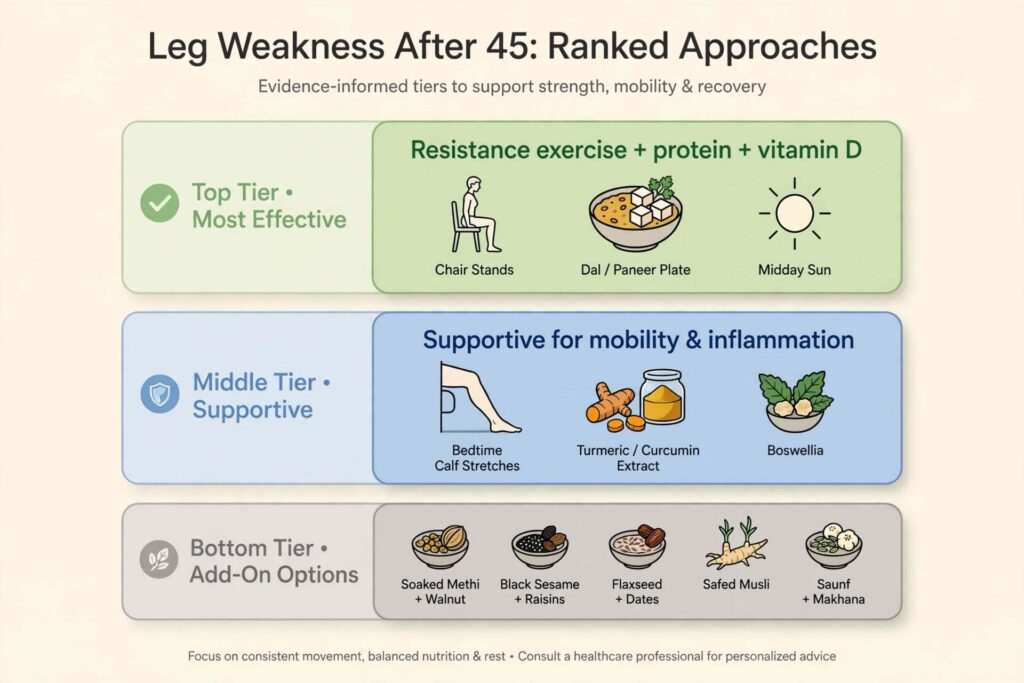
The five popular home remedies for leg weakness, graded
Here’s the verdict on these home remedies for leg weakness first, then the detail.
| Remedy | What it claims | What the evidence says | Verdict |
|---|---|---|---|
| Methi + walnut | Cuts joint inflammation, strengthens muscle | Mostly lab and animal data for methi; walnut gives some plant omega-3 | Harmless, unproven for joints |
| Black sesame + raisins | Builds bones; raisins “unlock” calcium | Sesame is a calcium source; no sign raisins boost absorption | Sesame yes, raisin claim no |
| Flaxseed + dates | “Lubricates” joints, instant energy | Flax is good fibre and ALA; no joint-lubrication evidence | Healthy food, wrong promise |
| Safed musli + almonds | Builds muscle and strengthens nerves | No solid human data on muscle; almonds are nutritious | Unproven |
| Saunf + makhana | Stops night cramps | No trials for cramps | Unproven |
| Lemon water, morning sun, mustard oil massage | Improve absorption, vitamin D, circulation | Sun timing is wrong for vitamin D; the rest is thin | Mostly fix the details |
None of these home remedies for leg weakness will harm most people. What I’d push back on is the idea that they replace the things with the best evidence, which are strength training, enough protein, and fixing vitamin D if it’s low.
Home remedies for leg weakness, remedy by remedy
1. Methi dana and walnut as home remedies for leg weakness
Fenugreek (methi) is a traditional anti-inflammatory, and the research behind the usual claim is mostly lab and animal work on compounds in the seed. I couldn’t find strong human trials showing that soaked methi seeds relieve joint inflammation or strengthen muscle. Walnuts contribute alpha-linolenic acid (ALA), a plant omega-3. Two walnuts supply well under a gram, and your body converts only a small share of ALA into the longer omega-3s linked with anti-inflammatory effects.
Practical notes: methi can lower blood sugar, so people on diabetes tablets or insulin should be careful, and it can cause gas, loose stools and a maple-like body odour. Avoid it in pregnancy. If you take blood thinners, ask your doctor. Soaking walnuts and discarding the water is harmless and slightly reduces bitterness and phytic acid, but the claim that the soaking water blocks other nutrients isn’t something I’d lose sleep over.
2. Black sesame and raisins as home remedies for leg weakness
This is the best idea on the list, with one correction. Sesame seeds really are rich in calcium. A tablespoon of unhulled sesame (about 9 g) gives roughly 90 mg, which is about 30% of the calcium in a glass of milk. The caveat is absorption: sesame contains oxalate and phytate, which reduce how much your body takes up, so the real contribution is lower than the number on paper.
The raisin part is where the explanation goes wrong. Raisins contain a little boron and potassium, and potassium may reduce calcium lost in urine, but there’s no good evidence that raisins “unlock” calcium absorption. What controls calcium absorption is mainly your vitamin D status, how much calcium you take at one time (your gut absorbs it best in doses of about 500 mg or less) and what else is on your plate. Raisins are also about two-thirds sugar, so if you have diabetes, our guide to raisins benefits explains the portion question.
If bones are your worry, the foods with the most calcium per rupee are milk, curd, paneer, ragi (finger millet, around 350 mg per 100 g) and leafy greens like amaranth and drumstick leaves. The ICMR-NIN guidelines put adult calcium needs at about 1,000 mg a day, and most people eating a typical vegetarian Indian diet fall short.
3. Flaxseed and dates as home remedies for leg weakness
Flaxseed is a nutritious food. It supplies fibre, lignans and ALA, and grinding it matters, because whole seeds often pass through undigested. The idea that its omega-3s “lubricate” your joints isn’t how joints work. Joint cartilage and synovial fluid aren’t topped up by dietary oil, and I found no trials showing flax improves stiffness. Roasting is fine, and a tablespoon or two a day is plenty. If you take blood thinners or have a hormone-sensitive condition, check with your doctor first.
Dates provide quick carbohydrate, potassium and a little magnesium. Two dates give about 130 kcal and around 30 g of sugar, which is a fair amount if you have diabetes. They’re a decent pre-walk energy snack. They don’t reduce pressure on your joints.
4. Safed musli and almonds as home remedies for leg weakness
Safed musli (Chlorophytum borivilianum) is a prized Ayurvedic root, sold mainly as a general tonic and for male vitality. The claim that its saponins increase muscle protein synthesis isn’t established in humans. The evidence I could find is mostly animal and lab work, with small, mixed human data on other outcomes. There’s no validated dose (the 10 g quoted in the video isn’t from a trial), and the herb has a reputation for adulteration. Pregnant women, people with diabetes and anyone on regular medicines should talk to a doctor before using it.
Almonds are nutritious: vitamin E, magnesium, some protein and healthy fat. Ten almonds give roughly 70 kcal and about 2.5 g of protein, so they help, but not in the way the claim suggests. I’m not aware of evidence that they “strengthen nerves” or reduce falls.
5. Saunf and makhana: home remedies for leg weakness at night
Saunf (fennel) contains anethole, which relaxes smooth muscle in lab studies. That’s the muscle in your gut and uterus, not the skeletal muscle in your calf, and I found no trials showing fennel prevents leg cramps. Makhana (fox nut) gives a modest amount of calcium and protein: about 30 g supplies roughly 50 mg of calcium. A bowl of makhana in milk at night is a pleasant snack. It isn’t a proven cramp treatment.
And the cause as stated, “cramps are due to low magnesium and calcium”, is an oversimplification. I’ll cover what the research really shows in the cramp section below.
What the research says beats home remedies for leg weakness: building leg strength
Here’s the part home remedies for leg weakness lists leave out, and it’s by far the most important.
Resistance training, the best of the home remedies for leg weakness. Resistance exercise is one of the best-supported non-drug strategies for muscle strength in older adults, and the evidence holds well into the 70s, 80s and beyond. Two to three sessions a week is the usual recommendation.
Enough protein, spread across meals. Older muscles respond less to protein than young ones, so older adults generally do better with around 1.0 to 1.2 g of protein per kilogram of body weight per day, spread over meals instead of loaded into dinner. For someone weighing 65 kg, that’s roughly 65 to 78 g a day, or about 20 to 25 g at each main meal. A Chinese meta-analysis of resistance training plus supplements in older adults with sarcopenia found that compound supplements containing protein and vitamin D improved grip strength and gait speed compared with exercise alone, although the effect on muscle mass was less clear.
An honest caveat. A separate meta-analysis of 22 trials in healthy older adults found that adding nutritional supplements to resistance training didn’t produce clear extra gains in muscle mass, strength or function, except for creatine, which did help muscle mass. So the order of importance is exercise first, then adequate everyday protein, then targeted extras.
Night cramps: which home remedies for leg weakness actually help
Night-time leg cramps send many people hunting for home remedies for leg weakness (surveys put them at about 40% of people over 50) and they wake people up. The evidence is more sober than the remedy lists suggest.
Magnesium doesn’t work for most older adults. A Cochrane review pooled 11 studies with 735 people and found no meaningful reduction in cramp frequency or severity in older adults. A later randomised trial of magnesium oxide in older adults with night cramps found it no better than placebo. Calcium and magnesium shortages can cause cramps, but they’re an uncommon explanation, and a blood test can check.
Stretching has modest support as a home remedy for leg weakness cramps. A 2012 randomised trial in 80 adults over 55 found that stretching the calves and hamstrings just before bed reduced both the number and severity of night cramps compared with no stretching. Other trials have been less positive, so I’d call it worth trying, not guaranteed. It’s free, and it has a better evidence base than any seed.
Check your medicines first. Several common drugs are linked with cramps, including diuretics (water tablets), statins, long-acting asthma inhalers, some blood pressure and osteoporosis medicines. Don’t stop anything yourself, but if your cramps began after a new prescription, raise it with your doctor.
Other things to check: dehydration, diabetes, an underactive thyroid, kidney problems and, in some cases, low vitamin B12. One small trial found vitamin B complex helped older adults with night cramps, though it’s too small to rely on.
What’s not recommended: quinine is no longer advised for cramps because of serious side effects.
A simple bedtime routine, based on the trial: stand facing a wall, hands on it, one foot back with the heel down, and lean in until you feel a calf stretch. Hold for 10 to 20 seconds, repeat a few times each side, then stretch the back of the thigh, for example by sitting with a leg straight and reaching towards your toes. If a cramp strikes, straighten the leg, pull your toes towards you, and walk on your heels until it eases.
Vitamin D and sunlight: a correction to the usual home remedies for leg weakness
The video suggests sitting in the sun between 7 and 9 a.m. for 15 minutes. For vitamin D, that’s the wrong time.
Your skin makes vitamin D from UVB rays, and UVB is strongest around midday, from roughly 10 a.m. to 3 p.m. Early-morning and late-afternoon sun contains much less UVB, so it produces little vitamin D, even though it’s gentler on the skin and good for your body clock and mood. Darker skin, which most Indians have, makes vitamin D more slowly and typically needs several times longer exposure than pale skin. Glass windows block UVB, sunscreen cuts production sharply, and air pollution in cities reduces it further.
Vitamin D deficiency is extremely common here. Reviews report prevalence figures between about 50% and 94% in community studies, and a 2025 meta-analysis cited in Indian coverage put pooled deficiency near two-thirds. Low vitamin D is linked with muscle weakness, falls and bone loss, and in older adults, combining resistance exercise with vitamin D3 has tentative support for improving strength.
So here’s what I’d suggest instead of guessing:
- Get tested. A 25-hydroxy vitamin D blood test costs little and takes the guesswork out.
- If you want sun, aim for midday, with arms and legs exposed for a short time, avoiding burning and the hottest hours if you’re heat-sensitive. Morning sun is still worth having for your sleep rhythm, just not as your vitamin D plan.
- If you’re low, treat it under a doctor’s guidance. Dose and duration depend on your level, and too much vitamin D isn’t harmless.
- Food helps modestly. Eggs, fortified milk and fatty fish contain some vitamin D, but few Indian diets supply enough.
For more on the sun and your body clock, see our guide to light hygiene and circadian health.
Lemon water and mustard oil massage as home remedies for leg weakness
Lemon water. There’s no evidence it “activates the body” or noticeably improves nutrient absorption. Vitamin C does help you absorb plant-based iron, so a squeeze of lemon on a dal or sabzi meal has a small benefit, and our guide to amla benefits covers that. As a morning ritual, it’s harmless and mostly hydration.
Mustard oil massage. A warm massage on knees and calves is comforting and may ease tightness for a while, and the research on massage for muscle soreness is modest. Mustard oil isn’t special for circulation, and it can irritate skin, so patch-test it and avoid broken skin. It’s also not recommended for babies’ skin. If you want a topical with stronger evidence for knee arthritis, topical anti-inflammatory gels are a recommended option in osteoarthritis guidelines. Ask your doctor or pharmacist.
Ingredients I’d add to home remedies for leg weakness (and why)
Here are the extra ingredients for home remedies for leg weakness with the best evidence, ranked by how much I’d trust them.
| Ingredient | What it’s for | What the research shows | How to use it |
|---|---|---|---|
| Everyday protein foods (dal, paneer, curd, eggs, soy, fish, milk) | Muscle | Older adults need about 1.0 to 1.2 g/kg/day, spread across meals | 20 to 25 g at each main meal |
| Ragi | Calcium for bones | About 350 mg per 100 g; a plant source of calcium and fibre | Roti, dosa, porridge, a few times a week |
| Creatine monohydrate | Muscle strength with training | A 2026 meta-analysis found a small extra strength gain (g = 0.31) when added to resistance training in adults 60+; earlier analyses suggested extra muscle mass | 3 to 5 g a day, only alongside exercise; check kidney health first |
| Vitamin D3 (if low) | Muscle and bone | Tentative support for combining with resistance training | Test first; dose under medical advice |
| Curcumin (turmeric extract) | Knee osteoarthritis pain | A 2022 meta-analysis of 15 trials (1,670 people) found less pain than placebo and results not inferior to NSAIDs; a 2025 network meta-analysis found all turmeric preparations reduced pain, with low certainty | Trials used concentrated extracts; ask your doctor |
| Boswellia (shallaki) | Knee osteoarthritis pain | An 11-trial meta-analysis (1,009 people) found benefit over placebo, though trial quality was low | Extract only, doctor-guided |
| Fish or algae omega-3 | General inflammation, heart | Stronger evidence for rheumatoid arthritis than for osteoarthritis | Fish twice a week, or algae oil for vegetarians |
| B-vitamin check (B12) | Nerves, weakness, numbness | Common deficiency in Indian vegetarians | Blood test, treat if low |
A few honest notes on that home remedies for leg weakness table.
Creatine is the surprising one. It’s usually thought of as a gym supplement, but a 2026 meta-analysis of resistance training with creatine in older adults found a small but significant extra gain in strength compared with training alone, and earlier meta-analyses suggested added muscle mass. The extra effect on everyday physical function is still uncertain. It only makes sense alongside exercise. Our piece on nootropics covers its safety profile in more detail.
Curcumin and boswellia have more evidence for knee osteoarthritis than most remedies on the original list, though the quality is low and most trials are small. The trials used concentrated extracts, often with something to improve absorption, so a spoon of turmeric in milk delivers far less. If you take blood thinners, diabetes medicines, or have gallstones or liver disease, check with your doctor before using turmeric extracts.
Ashwagandha is popular for strength. A few small trials, mostly in young men doing resistance training, have reported larger strength gains, but many were industry-linked, and I wouldn’t build a plan around it. Our guides to adaptogens and shatavari and adaptogens cover what’s known.
What I’d skip among home remedies for leg weakness: magnesium for cramps (no benefit in older adults), safed musli for muscle (unproven) and any “joint lubrication” claims.
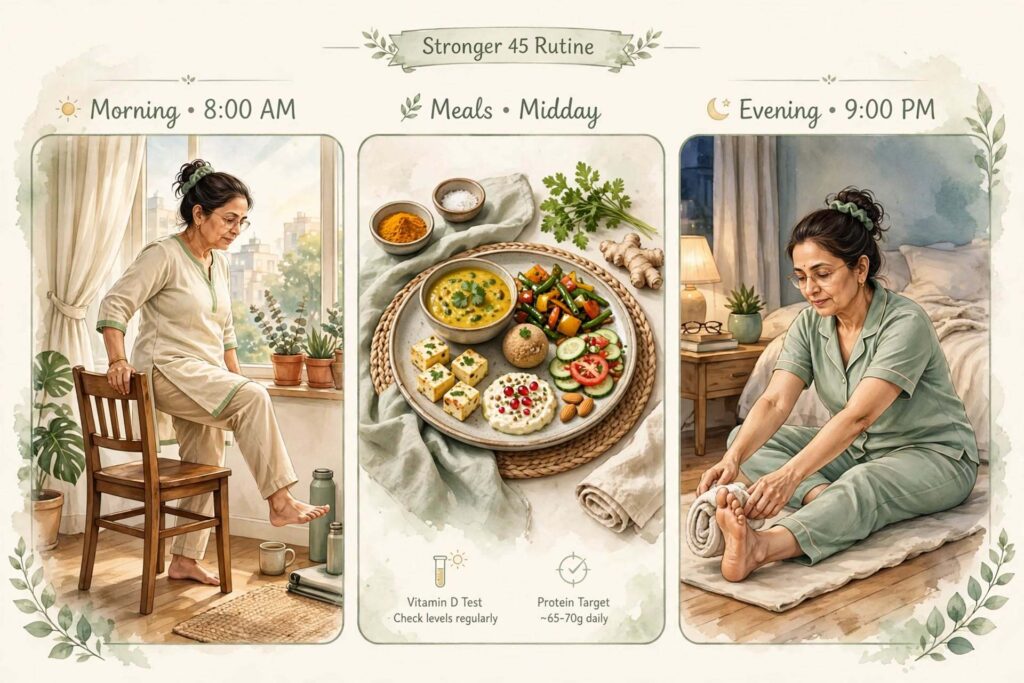
An advanced plan for home remedies for leg weakness, in six steps
Put together, here’s how I’d organise home remedies for leg weakness.
Step 1: Strength, 2 to 3 times a week. You don’t need a gym. Try sit-to-stand from a sturdy chair (aim for 8 to 12 repeats, then add a second set, then do it without using your hands), calf raises holding a wall, step-ups on the bottom stair, hip bridges lying on your back, and a heel-to-toe walk for balance. Water bottles or a backpack can add weight later. Progress slowly. If you have a heart condition, severe arthritis or osteoporosis, ask your doctor or a physiotherapist first.
Step 2: Protein at every meal. Build 20 to 25 g into each. Roughly: a katori of cooked dal gives 8 to 9 g, a large egg 6 g, 100 g paneer about 18 g, a glass of milk about 8 g, 100 g curd about 4 g, and 25 g dry soya chunks around 13 g. Combine, for example, besan chilla with curd at breakfast, dal with roti and curd at lunch, and paneer or eggs at dinner. Those foods usually cost less per gram of protein than almonds, makhana and walnuts, which is worth knowing if you’re spending on a daily nut mix. Our guides to protein powder for women and sex-specific nutrition cover how much and when.
Step 3: Test and fix vitamin D, B12 and iron. A basic panel (vitamin D, B12, haemoglobin and ferritin, thyroid) catches the common fixable causes. Our guide to iron deficiency and anemia in women explains what to ask for.
Step 4: A bedtime routine for cramps. Calf and hamstring stretching, enough water through the day, and a check on your medicines.
Step 5: Look after the knees. Keep your weight in check, because every kilogram you lose takes several off the load on your knees when you walk. Stay active, use topical anti-inflammatory gels if your doctor agrees, and consider curcumin or boswellia extracts for knee osteoarthritis, with your doctor’s guidance.
Step 6: Balance and falls. Single-leg standing near a counter, a few times a day, builds balance. Tai chi and yoga help. Good lighting, non-slip mats and supportive footwear matter as much as any supplement.
Keep the home remedies for leg weakness habits easy enough to survive a busy week. Our guide to low-friction prevention explains how to attach them to routines you already have, and our guide to habits to quit for better health covers the salt, sugar and sleep side.
A realistic two-week start with home remedies for leg weakness
Days 1 to 3: do the calf and hamstring stretch before bed, add protein to breakfast, and book a vitamin D, B12, haemoglobin and thyroid test.
Days 4 to 10: start chair stands and calf raises three days a week, build protein to every meal, and get 20 to 30 minutes of midday sun if your doctor and skin allow, or chat about supplements if your levels are low.
Days 11 to 14: add step-ups and balance work, review your test results with your doctor, and decide on supplements. Expect to feel a bit better in two weeks if poor sleep and inactivity were part of the problem. Real strength gains take 8 to 12 weeks of regular training.
When to see a doctor instead of home remedies for leg weakness
Don’t rely on home remedies if you notice:
- Calf pain when walking that eases when you stop. This pattern, called claudication, can mean narrowed leg arteries, which is a heart attack and stroke risk marker.
- A swollen, warm, painful calf, especially on one side. This could be a blood clot and needs same-day care.
- Weakness that’s getting worse, a dragging foot, or trouble climbing stairs or rising from a chair.
- Numbness, tingling or burning in the feet, which can point to diabetes, B12 deficiency or a spinal problem.
- Back pain with leg symptoms, or loss of bladder or bowel control. This needs urgent attention.
- Morning stiffness lasting an hour or more, swollen joints or fever.
- Cramps that began after starting a new medicine, or that keep waking you most nights.
- Unexplained weight loss, extreme fatigue or new breathlessness.
- A fall, or fear of falling.
If you’ve been searching symptoms online first, our article on AI self-diagnosis and digital health explains how to use that research without letting it make the decision.
Where to go next
- Muscle and nutrition: Protein powder for women, Sex-specific nutrition for women, Nootropics (includes creatine)
- Bones, iron and vitamin D: Iron deficiency and anemia in women, Light hygiene and circadian health, Amla benefits
- Seeds, raisins and kitchen remedies: Raisins benefits, Habits to quit for better health
- Herbs and safety: Adaptogens, Shatavari and adaptogens, Supplement safety
- Women after 45: Perimenopause symptoms, Women’s hormonal health
- Habits that stick: Low-friction prevention
- More guides: Health & Wellness, Nutrition & Diet
Questions people ask about home remedies for leg weakness
What are the best home remedies for leg weakness after 45?
The best-supported ones are resistance exercise (two to three times a week), enough protein spread across meals, checking and correcting vitamin D, and a bedtime calf and hamstring stretch for night cramps. Soaked seeds and nuts are healthy foods, but none has been shown to rebuild leg strength on its own.
Do methi and walnut work among home remedies for leg weakness?
There’s little human evidence. The research on methi’s anti-inflammatory compounds is mostly lab and animal work, and walnuts provide only a small amount of plant omega-3. They’re safe for most people, though methi can lower blood sugar.
Does magnesium work among home remedies for leg weakness and cramps?
Not in older adults, according to a Cochrane review of 11 studies, and a later trial of magnesium oxide found it no better than placebo. Bedtime calf and hamstring stretching has better, though modest, evidence, and it’s worth checking whether a medicine is causing the cramps.
Is morning sun one of the best home remedies for leg weakness and low vitamin D?
No. UVB, the ray that makes vitamin D, is strongest from roughly 10 a.m. to 3 p.m. Early-morning sun is good for your body clock but makes little vitamin D. Get a blood test and take supplements if you’re low.
Do raisins make home remedies for leg weakness better for calcium?
There’s no good evidence that they do. Calcium absorption depends mostly on vitamin D, the dose at one sitting and other foods. Sesame, ragi, milk, curd and paneer are better calcium sources.
Is safed musli one of the good home remedies for leg weakness?
It’s unproven. The claims rest on animal and lab studies, and there’s no validated dose. Check with a doctor if you have diabetes, take regular medicines or are pregnant, and watch out for adulterated products.
How much protein do I need after 45 for home remedies for leg weakness to work?
A common recommendation for older adults is about 1.0 to 1.2 g per kg of body weight per day, spread across meals. For 65 kg, that’s about 65 to 78 g a day. Kidney disease changes this, so ask your doctor if you have it.
Does creatine belong with home remedies for leg weakness?
When added to resistance training, a 2026 meta-analysis found a small extra strength benefit in adults 60 and older, and earlier meta-analyses suggested more muscle mass. It isn’t a substitute for exercise, and kidney function should be checked first.
Does turmeric work among home remedies for leg weakness and knee pain?
Meta-analyses of trials in knee osteoarthritis found curcumin extracts reduced pain compared with placebo, and in some trials worked about as well as NSAIDs, though the certainty of evidence is low. Trials used concentrated extracts, not kitchen amounts of turmeric.
When are home remedies for leg weakness not enough?
If you have calf pain when walking that eases with rest, a swollen warm calf, worsening weakness or a dragging foot, numbness, back pain with bladder or bowel changes, or morning stiffness lasting more than an hour. These need medical assessment.
The short version
The most effective home remedies for leg weakness aren’t soaked seeds. They’re lifting your own body weight two to three times a week, eating protein at every meal, testing and fixing vitamin D, stretching your calves before bed, and looking after your knees. The five popular remedies are healthy foods with mostly unproven promises, and the claim that raisins unlock calcium, that magnesium stops cramps, and that 7 to 9 a.m. sun gives you vitamin D don’t hold up.
If you do one thing for home remedies for leg weakness this week, do three sets of sit-to-stand from a chair and a calf stretch before bed, and book a vitamin D test. Then add the protein. The kitchen can help, but the muscle has to be asked to work.
Disclaimer: this article is general education, not medical advice. Always consult a qualified healthcare professional about leg weakness, medicines, supplements and exercise, especially if you have heart disease, diabetes, kidney disease or are pregnant. See our full disclaimer.
Research referenced: the 2012 Cochrane review of magnesium for skeletal muscle cramps and the 2017 JAMA Internal Medicine trial of magnesium oxide for night cramps (Maor et al.); Hallegraeff et al., 2012, Journal of Physiotherapy, bedtime stretching and nocturnal leg cramps; the 2026 meta-analysis of resistance training with creatine in older adults and the 2014 creatine meta-analysis; the 2021 meta-analysis of resistance training with nutritional interventions; the 2023 meta-analysis of nutrition plus resistance training in sarcopenia; the 2017 BMJ Open review of resistance exercise with vitamin D3; the 2022 meta-analysis of curcuminoids for knee osteoarthritis, the 2025 network meta-analysis of turmeric products and the meta-analysis of curcumin and boswellia; and reviews of vitamin D deficiency and sun timing in India.




Leave a Reply