
A continuous glucose monitor for non-diabetics has gone from a niche biohacker curiosity to one of 2026’s most mainstream wellness purchases, with over-the-counter options like Dexcom Stelo and Abbott Lingo now sitting on pharmacy shelves next to blood pressure cuffs. The pitch is seductive: strap on a small sensor, watch your glucose respond to every meal in real time, and finally understand what’s actually happening inside your metabolism. What gets far less attention is a genuinely important, currently unsettled scientific question underneath that pitch — do the glucose “spikes” a CGM shows a healthy person actually mean anything, or is a device built to detect dangerous swings in diabetics being repurposed to manufacture anxiety over completely normal biology in people who were never at risk? This is the same evidence-versus-hype gap we found separating real research from wellness marketing in our look at ice baths and cold plunges. This guide walks through what a fresh 2026 systematic review and meta-analysis actually found, what a normal glucose response looks like, and who genuinely stands to benefit.
What a CGM Actually Does, and Why It Was Built for Diabetics First
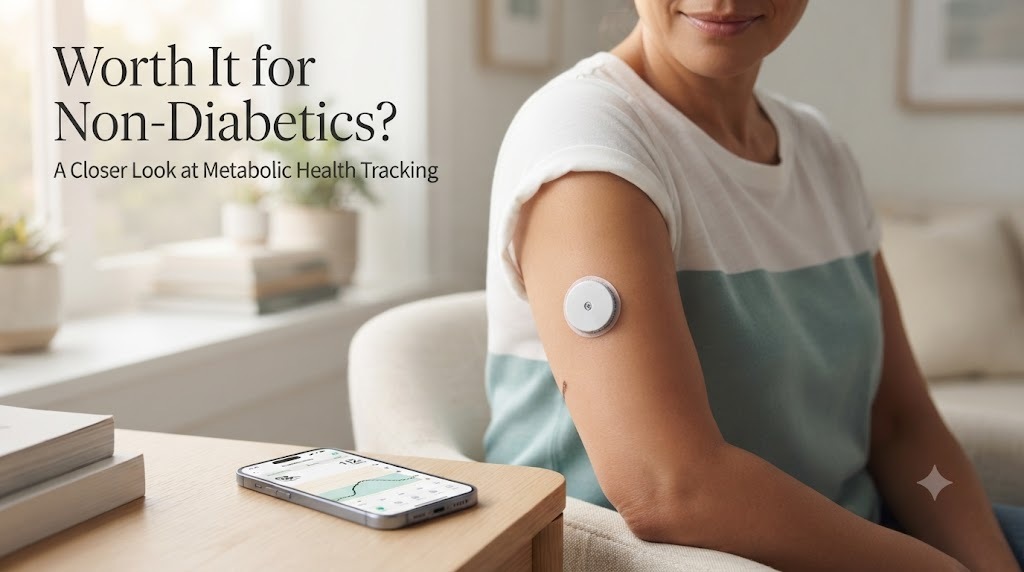
A continuous glucose monitor is a small sensor, typically worn on the back of the upper arm, that measures glucose in the interstitial fluid just beneath the skin every few minutes, sending real-time readings to a smartphone app. It was developed and validated specifically for people with diabetes, where tracking glucose trends helps fine-tune insulin dosing and catch dangerous highs and lows that a single fingerstick reading would miss entirely. The technology’s expansion into non-diabetic wellness use is recent, and the evidence base for that specific application is still catching up to the marketing.
What the Newest Research Actually Found
This is where the honest picture gets more nuanced than most CGM marketing lets on. A 2026 systematic review and meta-analysis published in the European Journal of Medical Research, pooling observational and interventional studies specifically in non-diabetic populations, found CGM use was associated with improved mean blood glucose and better adherence to dietary interventions — a genuine, measurable benefit for behavior change. But the same review was direct about its limits: evidence on CGM’s actual measurement accuracy and its effect on glycemic variability in non-diabetics remains limited, and critically, CGM alone did not achieve meaningful weight management results without an accompanying structured behavioral intervention. The reviewers’ own conclusion is worth repeating almost verbatim: CGM is best understood as a precision biofeedback tool integrated into a structured lifestyle program, not a standalone solution that works simply by wearing it.
A separate systematic review focused specifically on cardiovascular risk, examining studies from 2020 through 2025, looked at whether CGM-guided lifestyle changes in non-diabetic adults meaningfully improved cardiovascular risk factors — a more specific, harder-edged question than general “metabolic health.” The honest state of that evidence: promising directionally, but still too early and too heterogeneous across studies to draw firm conclusions about CGM specifically driving cardiovascular benefit, as opposed to the general dietary awareness that comes from tracking anything closely.
The Question Most CGM Marketing Skips: Are “Glucose Spikes” in Healthy People Actually a Problem?
This is genuinely the most important thing to understand before spending money on a CGM for wellness purposes, and it deserves more space than most reviews give it.
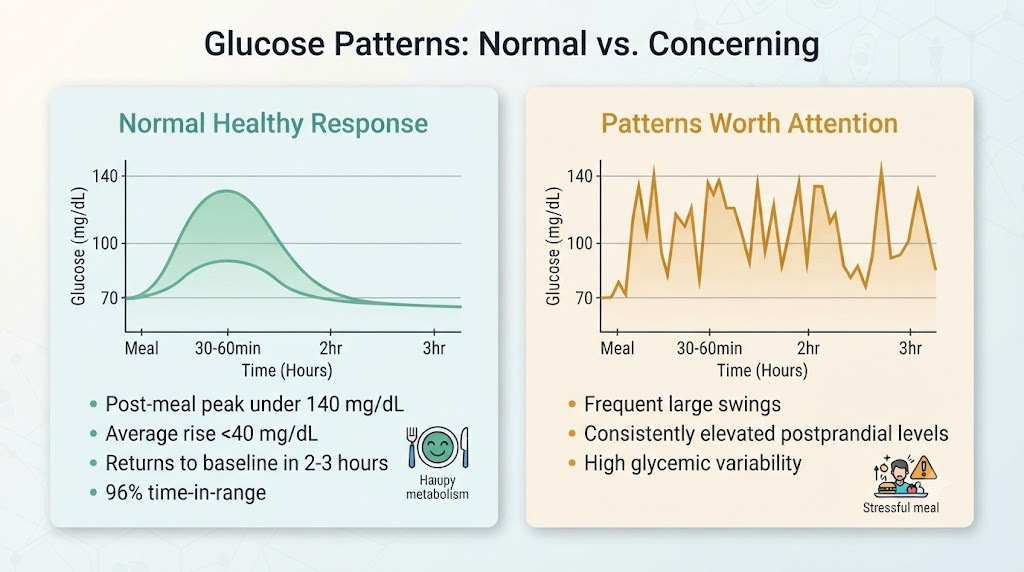
A 2026 scoping review specifically compared how “grey literature” (wellness blogs, CGM company marketing, influencer content) frames glucose spikes against what the actual peer-reviewed medical research shows. The finding is worth sitting with: despite online sources consistently framing glucose spikes as inherently harmful, the reviewed medical literature shows most healthy individuals maintain normal glucose levels the vast majority of the time — one cited study found people without diabetes spent 96% of their time within the standard healthy glucose range, even accounting for the ordinary spikes that follow every meal. In other words, the spike itself isn’t the abnormal event marketing often implies; a temporary rise after eating is completely normal physiology, not a warning sign.
To put real numbers on what “normal” actually looks like: postprandial glucose in healthy, non-diabetic adults typically peaks 30 to 60 minutes after eating, generally staying under 140 mg/dL, and returns to a pre-meal baseline within two to three hours. A study following 434 non-diabetic adults using CGM found an average one-hour post-meal rise of less than 40 mg/dL over a baseline in the mid-80s — a genuinely modest, expected fluctuation, not the alarming red spike a CGM app’s graph can make it look like without context.
Where the concern becomes genuinely legitimate: research does show that postprandial glucose specifically predicts cardiovascular risk even within the non-diabetic range, with one study finding a 27% higher cardiovascular risk when comparing the highest versus lowest quartile of post-meal glucose control. Higher glycemic variability — not single spikes, but frequent, large swings over time — has also been associated with increased cardiovascular and even Alzheimer’s disease risk in some research. The honest synthesis: consistently elevated or wildly variable glucose over time is worth caring about; a single post-lunch spike on a CGM graph, in an otherwise healthy person eating a normal meal, generally is not.
Accuracy: A Real Limitation Worth Knowing Before You Buy
CGMs measure glucose in interstitial fluid, not blood directly, which introduces a natural lag and margin of error even in well-validated devices. The standard accuracy measure, MARD (mean absolute relative difference), runs roughly 9-13% even for clinically validated CGMs used in diagnosed diabetic populations under monitored conditions. That means a reading of 120 mg/dL could reasonably reflect an actual blood glucose anywhere from roughly 105 to 135 mg/dL — a real margin that matters more when someone is making dietary decisions based on small, precise-looking numbers than when a diabetic is watching for large, clinically significant trends. This is a genuine engineering limitation, not a defect specific to any one brand, and it’s worth factoring into how much weight you put on any single reading, rather than treating the number on your phone as a precise lab result — the same “know the real margin, not just the marketing number” lesson we found digging into vitamin E dosing research.
Who Genuinely Benefits From a CGM Without a Diabetes Diagnosis
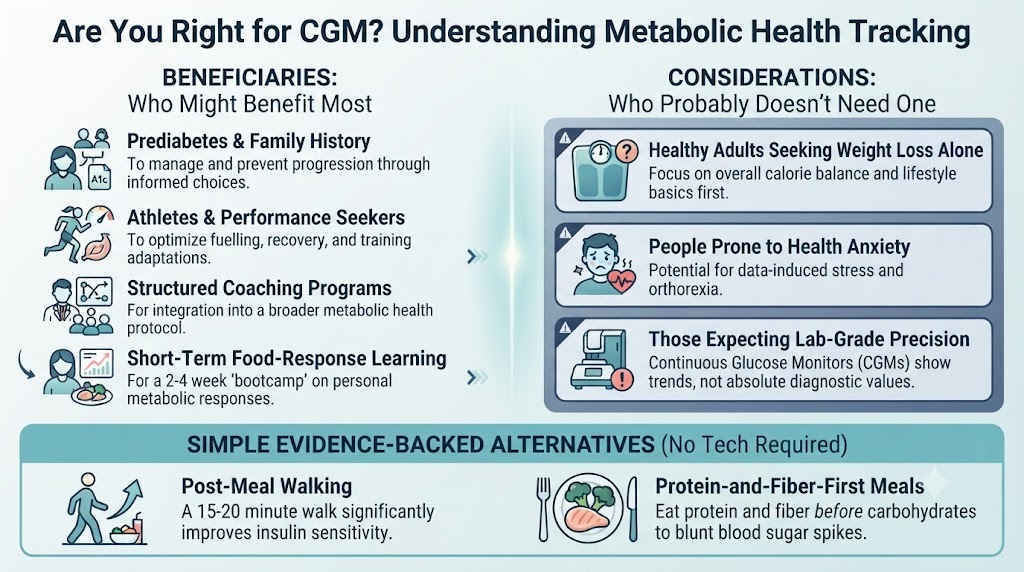
- People with prediabetes or a strong family history of type 2 diabetes, where early pattern recognition around specific foods can meaningfully support prevention efforts, ideally alongside a doctor’s guidance
- Athletes and highly active individuals optimizing fueling and recovery timing, where the emerging research on metabolic optimization in athletic populations shows genuine promise, even if still early-stage
- People in a structured, coached behavior-change program, where the 2026 meta-analysis specifically found CGM adds real value as a feedback tool — not used in isolation, but as one part of a broader plan
- Anyone using it short-term, curiously, to learn their personal response to specific foods — a few weeks of data can be genuinely educational without needing to become a permanent, anxiety-inducing habit
Who Probably Doesn’t Need One
- Healthy adults without risk factors, hoping a CGM alone will drive weight loss — the strongest current evidence says this specifically doesn’t work without a structured behavioral program layered on top
- Anyone prone to health anxiety or disordered eating patterns, where constant, granular data on every meal’s glucose response can reasonably feed obsessive tracking rather than healthier habits — this is a real, underdiscussed risk worth naming honestly, not unlike the caution we raised around self-directed nervous system regulation practices triggering unexpected reactions in some people
- People expecting lab-grade precision from consumer-grade accuracy, given the real MARD limitations discussed above
A More Useful Alternative for Most People
If your actual goal is better metabolic health rather than data for its own sake, several genuinely evidence-backed habits accomplish much of what CGM-driven awareness aims for, without the cost or the risk of over-interpreting normal biology. Walking for 10-15 minutes after meals has strong, direct clinical trial support for blunting post-meal glucose spikes — covered in detail in our guide to walking after meals for blood sugar control. Eating fiber and protein before carbohydrates at a meal, and prioritizing adequate daily protein generally, both slow glucose absorption through well-established mechanisms that don’t require a sensor to implement.
If you’re specifically trying to manage or prevent metabolic dysfunction rather than just satisfy curiosity, it’s also worth ruling out other contributors that a CGM alone won’t reveal — chronic stress and elevated cortisol genuinely affect blood sugar regulation, covered in our fact-check on cortisol and what actually affects it, and thyroid dysfunction can independently disrupt metabolic markers, covered in our guide to natural support for hypothyroidism. A CGM shows you glucose; it doesn’t diagnose why an underlying pattern exists.
What CGMs Actually Cost in 2026
Over-the-counter options like Dexcom Stelo and Abbott Lingo have brought pricing down considerably from earlier prescription-only models, typically running in the range of $50-$100 per month depending on sensor frequency and whether you’re using a bundled app subscription like Levels on top of the hardware. This is a real, recurring cost worth weighing against the actual evidence above — a few months of data to learn your personal patterns is a different financial and practical decision than an indefinite subscription habit.
When to See a Doctor Instead of Self-Monitoring
- Symptoms of diabetes — excessive thirst, frequent urination, unexplained fatigue, blurry vision — regardless of what a personal CGM shows
- A fasting glucose reading consistently at or above 126 mg/dL, or any single reading suggesting you should be formally tested
- A family history of diabetes combined with any metabolic symptoms, where proper diagnostic testing (HbA1c, fasting glucose, oral glucose tolerance test) is more reliable than self-interpreted consumer CGM data
- Noticing a pattern that concerns you on a personal CGM — bring the data to a doctor for interpretation rather than self-diagnosing from an app’s built-in scoring system
Frequently Asked Questions
Do continuous glucose monitors actually work for non-diabetics? They provide real, measurable behavioral feedback — a 2026 meta-analysis found CGM use improved mean glucose and dietary adherence in non-diabetic populations. However, the same review found CGM alone doesn’t achieve weight management goals without a structured behavioral program alongside it, and evidence on accuracy specifically in non-diabetics remains limited.
Is a glucose spike after eating actually dangerous for a healthy person? Generally no. A 2026 scoping review found that despite wellness marketing framing spikes as inherently harmful, most healthy people stay within normal glucose range roughly 96% of the time, and a moderate post-meal rise is standard physiology, not a warning sign, in someone without diabetes or prediabetes.
How accurate are consumer CGMs? Even clinically validated CGMs carry a mean absolute relative difference (MARD) of roughly 9-13% compared to precise blood glucose measurement. This means small differences between readings shouldn’t be over-interpreted, though the devices are reliable enough to show meaningful trends over time.
What is a normal blood sugar level after eating for someone without diabetes? Typically under 140 mg/dL at the 30-to-60-minute peak, returning to a pre-meal baseline within two to three hours. Research suggests the average rise in healthy adults is often less than 40 mg/dL above baseline.
Can a CGM help me lose weight if I don’t have diabetes? Not reliably on its own, according to current evidence. The most recent meta-analysis specifically found CGM improves adherence and behavior awareness but doesn’t independently drive weight loss without a structured lifestyle intervention built around the data it provides.
Should someone with prediabetes get a CGM? This is one of the more genuinely supported use cases, particularly under a doctor’s guidance, since early pattern recognition can meaningfully support prevention efforts in a population already at elevated risk — a different risk-benefit calculation than a healthy person using one purely out of curiosity.
Is it worth buying a CGM just to see how my body responds to different foods? For a short, defined period — a few weeks to identify your personal patterns — this can be genuinely educational and doesn’t require an ongoing subscription. Treating it as a permanent daily tracking habit is where the evidence and the cost-benefit case both get considerably weaker.
Can wearing a CGM cause anxiety or unhealthy eating patterns? This is a real, underdiscussed risk. Constant, granular feedback on every meal’s glucose response can reasonably feed obsessive tracking behavior in people prone to health anxiety or disordered eating, and this risk deserves honest consideration before starting, not just after a problem develops.
How much does a CGM cost for someone without diabetes in 2026? Over-the-counter options like Dexcom Stelo and Abbott Lingo typically run $50-$100 per month depending on sensor type and any bundled app subscription, a meaningful recurring cost worth weighing against the specific, limited benefits current research actually supports.
What’s a better first step than buying a CGM for most healthy people? Evidence-backed habits like walking after meals, prioritizing protein and fiber earlier in a meal, and addressing underlying contributors like chronic stress or thyroid function typically deliver comparable metabolic benefit without the cost, the accuracy limitations, or the risk of over-interpreting normal glucose fluctuations.
The Bottom Line
A continuous glucose monitor for non-diabetics is a genuinely useful tool for a specific, narrower group of people than current marketing suggests — those with prediabetes, a strong family history, or a structured behavior-change program built around interpreting the data correctly. For the average healthy person hoping a sensor alone will reveal hidden metabolic dysfunction or drive weight loss, the most current, rigorous evidence available in 2026 doesn’t support that expectation, and a meaningful body of research suggests the “glucose spikes are dangerous” framing driving much of the wellness marketing overstates what a normal, healthy glucose response actually looks like. If you’re curious, a short, defined trial period is a reasonable way to learn your own patterns — just hold the data loosely, understand the real accuracy limitations, and don’t let a temporary post-lunch number convince you something is wrong when the underlying science says otherwise.
This article is for informational purposes only and is not a substitute for personalized medical advice. If you have symptoms of diabetes or a family history of metabolic disease, consult a physician for proper diagnostic testing rather than relying solely on a personal CGM for diagnosis.







Leave a Reply