
If you’ve spent any time on TikTok or Instagram lately, you’ve probably seen it: someone holding up their phone, comparing a “before” and “after” photo, claiming their rounder, puffier face is proof of “cortisol face” — a supposed side effect of chronic stress. The videos rack up millions of views, and the comment sections are full of people convinced they’re seeing the same thing in their own mirror.
So is it real? The honest answer, according to endocrinologists who actually treat cortisol disorders for a living, is: sort of, but almost certainly not in the way social media is describing it. Understanding the real science here matters, because the oversimplified version circulating online can either send people chasing expensive, unnecessary “cortisol detox” products, or worse, cause them to miss the signs of an actual hormonal condition that does need medical attention.
What Cortisol Actually Does (It’s Not Just a “Stress Hormone”)
Cortisol gets nicknamed the “stress hormone,” but that label undersells it. It’s produced by your adrenal glands and is involved in regulating blood sugar, blood pressure, metabolism, inflammation, and your sleep-wake cycle. It follows a natural daily rhythm — typically highest shortly after you wake up and lowest at night — and that rhythm matters as much as the actual amount circulating in your body.
Endocrinologists who treat cortisol disorders are often quick to point out that the goal in medicine is never simply “lower cortisol.” As one adrenal specialist put it in a recent interview, the real objective is restoring a normal rhythm, since the body genuinely needs cortisol to be high at certain points in the day. Without it, your body can’t function properly at all.
So Is “Cortisol Face” Actually Real?
Here’s where it gets nuanced. “Cortisol face” is not a recognized medical diagnosis — you won’t find it in any clinical textbook. What it seems to be describing, in a loose and often exaggerated way, is a real medical phenomenon called “moon face,” which is a hallmark symptom of a genuine condition called Cushing’s syndrome.
Cushing’s syndrome occurs when cortisol levels are severely and persistently elevated over a long period, most often due to a tumor on the pituitary or adrenal gland, or from long-term use of corticosteroid medications. It’s a serious, relatively rare condition, and moon face in this context comes packaged with other clear symptoms: thinning skin that bruises easily, a fatty hump between the shoulders, significant abdominal weight gain paired with thin limbs, high blood pressure, and noticeable muscle weakness.
For the average person going through a stressful week or month, this level of hormonal disruption simply isn’t happening. Everyday stress does raise cortisol, but not to the degree, or for the sustained duration, required to cause the dramatic facial changes associated with true Cushing’s syndrome.
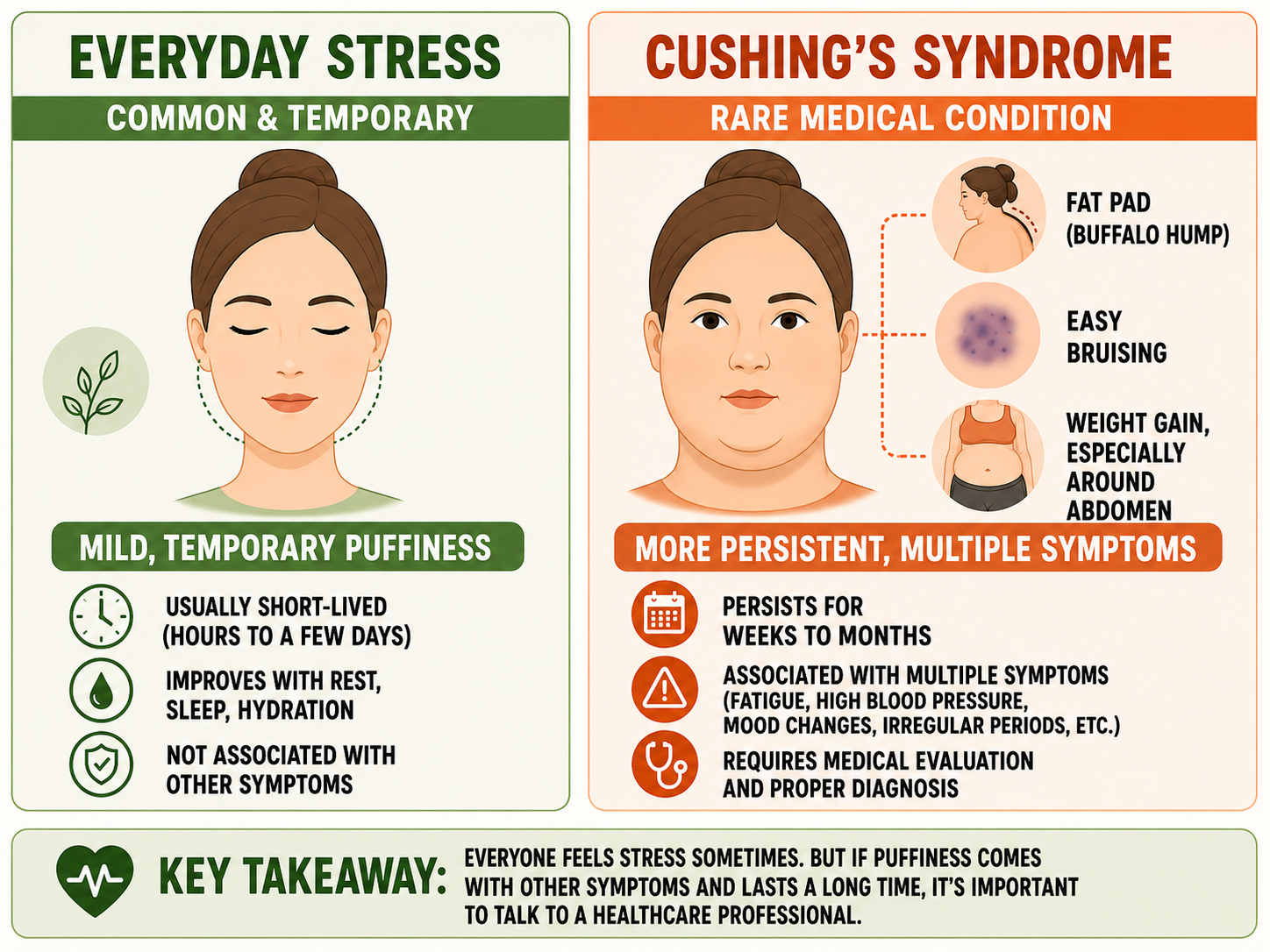
What’s Really Happening When Your Face Looks Puffy After a Stressful Week
That said, dismissing the observation entirely would be too simple too. Cortisol does influence fluid retention and how your body distributes fat, and elevated cortisol over shorter stretches of stress can plausibly contribute to mild, temporary facial puffiness or bloating for some people. It’s also worth remembering that poor sleep, high sodium intake, alcohol, allergies, and hormonal fluctuations can all cause similar temporary puffiness — and during a stressful period, several of these factors are often happening at once, making cortisol an easy (but not necessarily accurate) thing to blame.
If poor sleep has been part of your stress pattern, it’s worth knowing that sleep and cortisol regulate each other in both directions — poor sleep raises cortisol, and elevated cortisol makes it harder to fall and stay asleep. Our guide on optimizing sleep without relying on gadgets covers practical ways to break that cycle.
Recognized Symptoms of Genuinely High Cortisol
Rather than focusing on facial appearance alone, it’s more useful to know the broader symptom picture associated with chronically elevated cortisol:
- Weight gain concentrated in the midsection, face, or upper back
- Persistent fatigue, even after adequate sleep
- Trouble sleeping or staying asleep
- Brain fog or difficulty concentrating
- High blood pressure
- Muscle weakness, particularly in the thighs or shoulders
- Mood changes, including increased anxiety or irritability
- Irregular periods in women
If several of these symptoms are showing up together and persisting for weeks, that’s a conversation worth having with a doctor — not something to self-diagnose from a mirror or a TikTok trend. The only reliable way to actually know if your cortisol is elevated is through blood, saliva, or urine testing, ideally measured at multiple points in the day given cortisol’s natural rhythm.
The Gut-Brain-Cortisol Connection
Cortisol doesn’t operate in isolation. It’s deeply intertwined with your gut and nervous system — chronic stress raises cortisol, which can disrupt gut bacteria balance, which in turn can make it harder for your body to regulate stress efficiently going forward. It’s a feedback loop that compounds over time if left unaddressed. We go into this relationship in much more depth in our piece on the gut-brain connection and how it affects anxiety and mood, which pairs naturally with the strategies discussed here.
How to Actually Support Healthy Cortisol Levels
Because everyday stress-related cortisol elevation is usually mild and temporary rather than a medical emergency, most people don’t need dramatic interventions — just consistent habits that support your body’s natural rhythm.
1. Protect Your Sleep Schedule
Cortisol’s rhythm is tightly linked to your sleep-wake cycle. Going to bed and waking up at consistent times, even on weekends, helps keep that rhythm stable. Chronic sleep deprivation is one of the more well-established triggers for disrupted cortisol patterns.
2. Support Your Gut and Blood Sugar Through Diet
Since cortisol and blood sugar regulation are closely linked, eating patterns that stabilize blood sugar — regular meals with adequate protein and fiber rather than long gaps followed by sugar spikes — can help avoid unnecessary cortisol spikes throughout the day. Many of the same foods that support healthy blood sugar and satiety are covered in our article on natural foods that support metabolic health.
3. Move Your Body, But Don’t Overdo It
Moderate exercise helps regulate cortisol over time, but excessive high-intensity training without adequate recovery can actually keep cortisol elevated longer than intended. Balance matters more than intensity here.
4. Practice Genuine Stress-Reduction Techniques
Breathing exercises, time in nature, journaling, and social connection have all been associated with lower baseline cortisol levels in various studies. These aren’t quick fixes, but consistent practice over weeks tends to show measurable benefit.
5. Be Skeptical of “Cortisol-Lowering” Supplements and Detoxes
The wellness industry has capitalized heavily on cortisol anxiety, selling everything from “cortisol detox” powders to specialized supplements with limited evidence behind them. Some adaptogenic herbs have modest research support for stress support, but “detoxing” cortisol isn’t a real physiological process — your liver and kidneys already clear it naturally as part of its normal cycle.
Frequently Asked Questions
1. Is cortisol face a real medical condition? Not as a formal diagnosis. What’s being described online is usually a milder, temporary version of “moon face,” a symptom of the genuine medical condition Cushing’s syndrome, which requires much more severe and sustained cortisol elevation than everyday stress typically causes.
2. Can stress alone cause noticeable facial changes? For most people, everyday stress causes only mild, temporary puffiness at most, often related to fluid retention, poor sleep, or other overlapping factors rather than cortisol acting alone. Dramatic or persistent facial swelling warrants a medical evaluation rather than a self-diagnosis.
3. How can I actually find out if my cortisol is high? The only reliable method is testing — blood, saliva, or urine cortisol tests, sometimes measured at multiple times of day because cortisol naturally fluctuates. Symptoms and appearance alone aren’t enough to confirm elevated cortisol.
4. Do cortisol-lowering supplements actually work? Evidence varies by supplement. Some adaptogenic herbs have modest research support for general stress reduction, but claims about “detoxing” or dramatically lowering cortisol are largely unsupported. Talk to a doctor before starting any supplement, especially if you’re already taking medication.
5. When should I actually see a doctor about cortisol symptoms? If you’re experiencing several symptoms together — unexplained weight gain, high blood pressure, muscle weakness, easy bruising, or persistent fatigue — especially if they’re worsening over weeks or months, it’s worth getting evaluated rather than assuming it’s just stress.
The Bottom Line
“Cortisol face” makes for a compelling TikTok hook, but the reality is more nuanced than the trend suggests. Genuine, medically significant cortisol elevation is real, but it looks quite different from a puffy face after a hard week — and it comes with a broader, more serious set of symptoms that shouldn’t be self-diagnosed from a mirror. For most people dealing with everyday stress, the more useful focus isn’t chasing a “cortisol detox,” but building consistent habits — better sleep, steadier blood sugar, genuine stress management, and healthy skepticism toward miracle supplements — that support your body’s natural rhythm over time.
- CGM for Non-Diabetics: Is Continuous Glucose Monitoring Worth It (and What the Evidence Says)

- Postbiotics: What They Actually Are, What the Evidence Says, and Whether They’re Worth Buying

- Lymphatic Drainage: What It Can (and Can’t) Do for Detox, Swelling, and Recovery

- Nervous System Regulation: A Practical Guide (Beyond Breathwork and Ice Baths)

- Vagus Nerve Reset: What Actually Works (and What’s Just Viral Breathing)

DISCLAIMER:-
This article is for informational purposes only and is not a substitute for professional medical advice. If you’re concerned about symptoms of high cortisol, please consult a licensed healthcare provider for proper testing and evaluation.


Leave a Reply