If you’re on Ozempic, Wegovy, Mounjaro, or Zepbound, you’ve probably already heard the good news — real, sustained weight loss — and possibly a less-discussed downside: a real risk of losing muscle along with the fat. Learning how to preserve muscle mass on GLP-1 medications has become one of the most searched health topics of 2026, and for good reason — GLP-1 use has exploded, and the muscle loss conversation hasn’t kept pace with the weight-loss hype.
This guide isn’t about the medication itself — that’s a conversation for you and your prescribing doctor. It’s about the nutrition and training strategies with real evidence behind them for protecting the muscle you have while you lose weight.
Table of Contents
- Why GLP-1 Drugs Can Cause Muscle Loss
- How Much Protein You Actually Need to Preserve Muscle Mass on GLP-1
- Resistance Training: The Non-Negotiable Second Piece
- Practical Strategies When Appetite Is Low
- Who’s at Higher Risk of Muscle Loss
- When to Talk to Your Doctor
- Frequently Asked Questions
Why GLP-1 Drugs Can Cause Muscle Loss
GLP-1 medications work partly by suppressing appetite and slowing digestion, which is exactly what drives the weight loss — but it also makes it easy to under-eat protein without realizing it. Research indicates that roughly 25–40% of total weight lost on GLP-1 medications can come from lean muscle mass rather than fat, though this appears to be largely consistent with what happens during any significant weight loss, not a unique effect of the drugs themselves.
The concern isn’t cosmetic. Muscle plays a functional role in metabolism, mobility, and long-term health — losing too much of it during rapid weight loss can leave you lighter on the scale but weaker and more metabolically vulnerable than intended.
How Much Protein You Actually Need to Preserve Muscle Mass on GLP-1
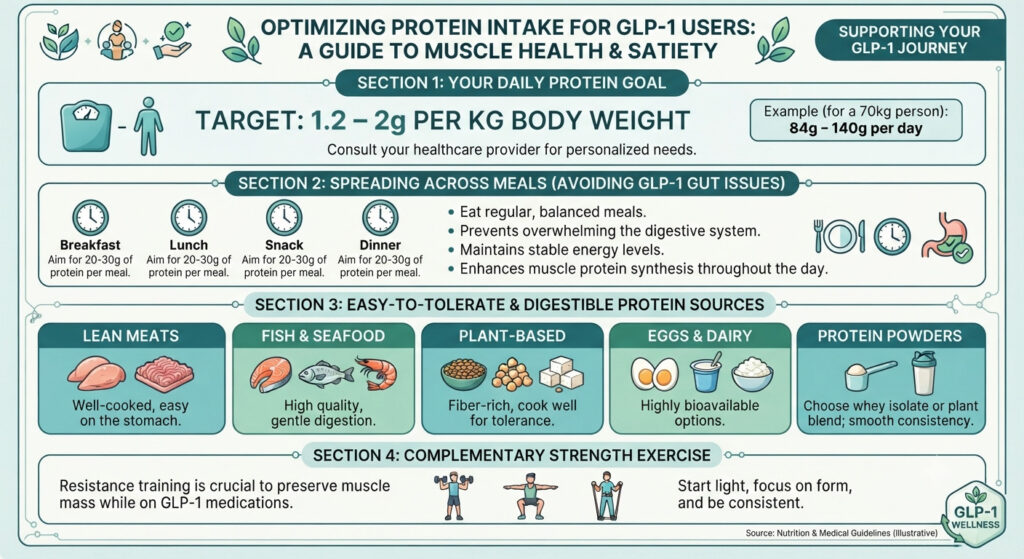
This is the single most important lever for protecting lean mass. Evidence-informed recommendations generally fall in the range of 1.2 to 2 grams of protein per kilogram of body weight per day — noticeably higher than standard dietary guidelines, and higher than most people eat by default, especially with a suppressed appetite.
To translate that into a real number: take your body weight in pounds, divide by 2.2 to get kilograms, then multiply by your target (1.2–1.6 is a reasonable starting range for most people). For a 160-pound person, that’s roughly 87–116 grams of protein daily — a meaningful jump from typical intake.
A few practical notes that matter as much as the total number:
- Spread it across meals. Research suggests distributing protein across 3–4 meals supports muscle protein synthesis better than one or two large servings, aiming for roughly 25–40 grams per meal where possible.
- Prioritize protein first, especially when appetite is low. When nausea or early fullness limits how much you can eat, structure meals so protein is the first thing on the plate, not an afterthought.
- Lean into easy-to-tolerate sources. Eggs, Greek yogurt, cottage cheese, lean meats, and protein shakes tend to be better tolerated than large, heavy meals when GLP-1-related nausea is a factor.
If digestion is part of what’s making it hard to hit these targets, our guide on why your muscles aren’t growing despite gym and diet covers related digestive and nutrient-absorption factors worth understanding alongside your protein targets.
Resistance Training: The Non-Negotiable Second Piece
Protein alone isn’t enough — the research is consistent that combining adequate protein with resistance training reduces lean mass loss substantially more than diet changes alone. Cardio is valuable for cardiovascular health, but it doesn’t send the same “preserve this muscle” signal to your body that strength training does.
Most guidance from physical therapists and researchers points to strength training two to four times per week, even at a modest starting volume. You don’t need to be an experienced lifter — bodyweight exercises like squats, push-ups, and planks, or resistance bands, can meaningfully help, especially for people just starting out. The key is consistency and progressively challenging your muscles over time, not intensity from day one.
Early evidence, including registered clinical research currently underway, suggests resistance training may help preserve lean tissue during GLP-1 treatment specifically, though researchers note more dedicated studies are still needed to fully confirm how much it offsets drug-related lean mass loss.
Practical Strategies When Appetite Is Low
Low appetite is often the biggest practical obstacle to hitting protein targets on a GLP-1 medication. A few strategies that tend to help:
- Front-load protein early in the day, when appetite and nausea are often milder for many people
- Keep a protein shake or bar on hand as a backup when a full meal feels like too much
- Avoid aggressive additional calorie restriction on top of what the medication is already doing — very rapid weight loss (more than about 1% of body weight per week) tends to increase the proportion of muscle lost relative to fat
- Stay ahead of hydration, since dehydration can worsen nausea and fatigue, both of which make eating enough protein harder
Who’s at Higher Risk of Muscle Loss
A few groups should pay particularly close attention to muscle preservation while on GLP-1 medications:
- Older adults, since age-related muscle loss (sarcopenia) compounds with medication-driven lean mass loss
- Anyone losing weight very rapidly, since faster weight loss tends to come with a higher proportion of lean mass loss
- People who skip resistance training entirely, relying on the medication and diet alone
- Those with limited baseline muscle mass going into treatment, who have less to lose before it affects strength and function
When to Talk to Your Doctor
Reach out to your prescribing doctor if you experience unusual fatigue, noticeable weakness, dizziness, or hair thinning while on a GLP-1 medication — these can sometimes signal inadequate nutrition or excessive lean mass loss and are worth evaluating rather than dismissing as a normal side effect. A doctor or registered dietitian can also help you set a personalized protein target and confirm your dosing and rate of weight loss are appropriate for your situation.
Frequently Asked Questions About Preserving Muscle Mass on GLP-1
How much protein do I need to preserve muscle mass on GLP-1? Most evidence-informed guidance recommends 1.2 to 2 grams of protein per kilogram of body weight daily, spread across 3–4 meals, though your specific target should account for your activity level and overall health — a registered dietitian can help personalize this.
Is cardio enough to prevent muscle loss on Ozempic or Wegovy? No. Cardio supports cardiovascular health but doesn’t provide the same muscle-preserving stimulus as resistance training. Strength training 2–4 times per week, combined with adequate protein, is the combination with the strongest evidence behind it.
How much muscle do people typically lose on GLP-1 medications? Research suggests roughly 25–40% of total weight lost can come from lean muscle mass if no preventive measures are taken, though this proportion appears similar to what happens during rapid weight loss more broadly, not unique to GLP-1 drugs specifically.
Can I start resistance training if I’ve never done it before? Yes. Even beginners can meaningfully reduce muscle loss with consistent, modest resistance training — bodyweight exercises or light resistance bands are a reasonable starting point, ideally under some guidance to ensure good form.
A Note From Health Morph
This article is for informational purposes only and isn’t a substitute for personalized medical advice. Any questions about your GLP-1 medication, dosing, or symptoms should go directly to your prescribing doctor. If you’re adjusting your diet or starting a new exercise routine, especially alongside a new medication, checking in with a doctor or registered dietitian first is a smart move.
For more evidence-based nutrition guidance, explore our Nutrition & Diet section, or read our related guide on supporting healthy cholesterol naturally for more on nutrition strategies during a weight-management journey.
The bottom line: you can preserve muscle mass on GLP-1 medications, but it takes intentional protein intake and consistent resistance training — it won’t happen automatically alongside the weight loss.







Leave a Reply