Aparajita climbs over gate posts and garden walls all across India, and for most of us it was just the blue flower you saw in a temple or plucked as a child. Today the same flower sells as blue tea in cafés for a few hundred rupees a cup, and butterfly pea flower tea has collected a set of health claims to match the price: it flattens sugar spikes, helps you lose weight, repairs your skin. Some of that has real science behind it. A fair amount is a small study stretched into a promise.
I went to the original papers on butterfly pea flower tea. Below you’ll find what’s in the flower, what the one human trial on blood sugar actually tested (it’s tinier than the videos make it sound), what the skin research really is, which claims have no human evidence at all, how to brew it so you don’t waste the pigment, and who should skip it. I’ve also added the safety points that most posts on butterfly pea flower tea leave out.
General information only. Butterfly pea flower tea isn’t a treatment for diabetes or prediabetes. If you take diabetes medicine, blood thinners or are pregnant, read the safety section before you start.
What butterfly pea flower tea is made from
The plant is Clitoria ternatea, a climbing legume in the pea family. In India it’s called aparajita, and you’ll also hear girikarnika. In Thailand and Malaysia it’s long been used as a food colour and herbal drink, and in Indonesia it’s called telang. It’s caffeine-free, with a mild, slightly woody, grassy taste. Butterfly pea flower tea is a deep blue because the petals are rich in anthocyanins, a family of plant pigments that also gives blueberries and red cabbage their colour. The main ones in butterfly pea are delphinidin-based compounds called ternatins.
Two points that get muddled.
Shankhpushpi. In Ayurveda, the name shankhpushpi is attached to more than one plant, and Clitoria ternatea is one of them, alongside other herbs such as Convolvulus pluricaulis. So if a product says “shankhpushpi”, check which plant is inside. The studies discussed below refer to Clitoria ternatea specifically.
The colour change. Squeeze lemon into the tea and it turns purple or pink. That’s chemistry: anthocyanins act as natural pH indicators, blue in neutral water, pinker with acid. It’s a nice party trick and a rough check that the blue comes from a real anthocyanin pigment rather than a synthetic dye. But it isn’t a test of whether a product is pure butterfly pea. Red cabbage, for one, does the same.
The claims, and what the evidence says
Here’s the short scorecard before the detail.
| Claim | What the research shows | How firm |
|---|---|---|
| Slows the blood sugar spike after a sugary or starchy meal | One small trial: 15 healthy young men, extract with sucrose | Promising, very small |
| Won’t cause low blood sugar | Extract alone didn’t change fasting glucose in healthy men; no data in people on diabetes medicines | Unproven where it matters |
| Helps you lose weight by lowering insulin | No human trials | Speculation |
| Protects skin from UV damage | Lab studies on skin cells in a dish | Preliminary |
| Reduces wrinkles and adds glow | No human trials on drinking the tea | Unproven |
| Lowers blood pressure | Rat studies | Preliminary |
| Improves memory (shankhpushpi tradition) | Traditional use; animal work | Unproven in humans |
| Rich in antioxidants | Yes, in lab tests | True, but not the same as health benefit |
The blood sugar study behind butterfly pea flower tea, in detail
This is the study most videos point to, and it’s worth knowing what it was.
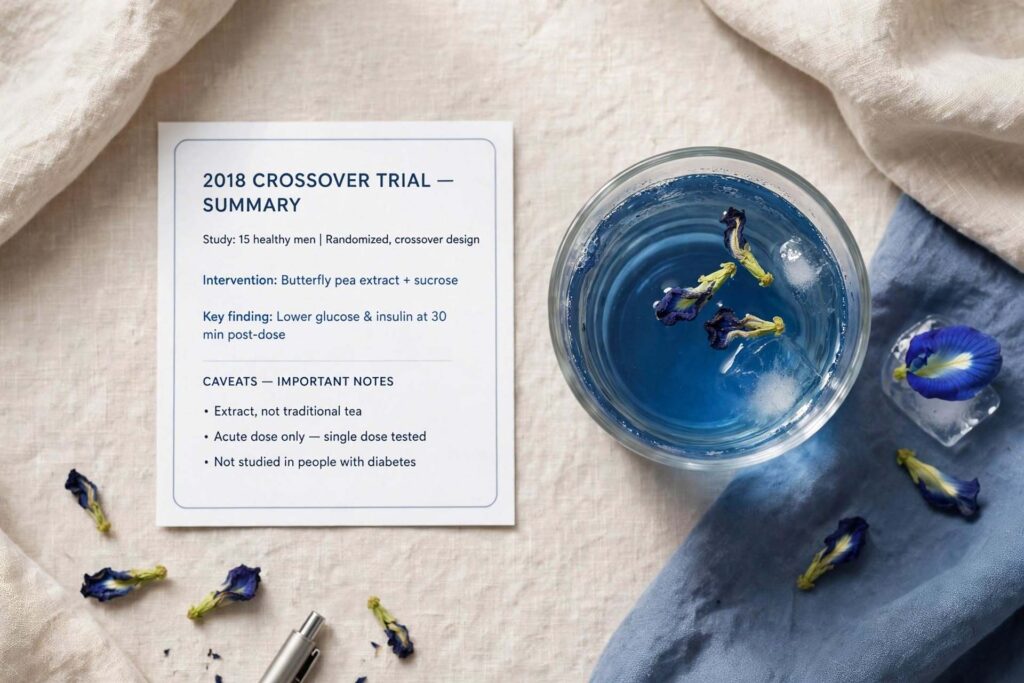
In 2018, researchers at Chulalongkorn University in Bangkok, working with colleagues in Singapore, published a randomised crossover trial in BMC Complementary and Alternative Medicine (Chusak and colleagues). Fifteen healthy men, around 22 years old with an average BMI of about 21.6, each drank five beverages on separate days, a week apart, including 50 grams of sucrose in 400 ml of water on its own, the extract on its own, and the same sugar drink with either 1 g or 2 g of the extract added. Blood was drawn over three hours.
What they found. When the extract was drunk together with the sugar, blood glucose and insulin were lower 30 minutes after drinking than with sugar alone, at both the 1 g and 2 g doses. When the extract was drunk alone, fasting, it didn’t change glucose or insulin. The researchers also noted higher antioxidant capacity in blood and less lipid peroxidation, a marker of oxidative damage.
That fasting result lines up with the advice you’ll hear to take butterfly pea flower tea with food, not on an empty stomach. And the finding about no change when fasting is why people say it doesn’t cause low blood sugar.
Now the caveats that rarely make it into the videos:
- 15 people. All healthy, lean, young men. No women, no one with prediabetes, diabetes or excess weight, and nobody taking medication.
- It was an extract, not a cup of tea. The researchers used a spray-dried aqueous extract. They measured about 1 mg of anthocyanin per gram of extract, so what’s in your mug depends on how many flowers you use and how you brew it.
- A big dose of pure sugar. Fifty grams of sucrose in water isn’t the same as rice, roti or dal.
- A single acute dose. It tells us nothing about what happens if you drink the tea daily for months.
- No outcome that matters. It measured glucose over three hours, not HbA1c, weight or complications.
- Registered after the fact. The trial was retrospectively registered, which is a minor flag on trial design.
The proposed mechanism fits: lab studies show the extract inhibits digestive enzymes such as alpha-amylase and alpha-glucosidase, which break down starch and sugar, so carbohydrate may be absorbed a little more slowly. Some diabetes medicines work on the same enzymes, but far more strongly.
A 2025 narrative review of the literature on butterfly pea flower and blood glucose summarised the picture honestly: animal studies consistently report lower glucose and better insulin sensitivity, while human evidence remains preliminary and limited to acute measurements. That’s the accurate position. A 2026 Indian clinical study tested a Clitoria ternatea-based tea on diabetic distress in people with type 2 diabetes, which shows human research is starting, but I couldn’t find results that change the overall picture.
What butterfly pea flower tea does and doesn’t mean for you
A cup of butterfly pea flower tea with a carb-heavy meal might slightly blunt the rise in blood sugar. It’s not an alternative to treatment. If you’re prediabetic, the strongest evidence is for lifestyle: in the famous US Diabetes Prevention Program, weight loss and regular activity cut the risk of developing type 2 diabetes by about 58% over three years, and no herbal tea has come close to that. Our guides to blood sugar, insulin resistance and habits to quit for better health cover what moves the needle. And if you’re curious how your own meals behave, our piece on CGM for non-diabetics explains how to test it properly.
Does butterfly pea flower tea lower insulin so you stop storing fat? A stretch too far
The explanation goes: spikes in blood sugar trigger insulin, insulin is a fat-storage hormone, so lowering the spike means less fat storage and easier weight loss. Insulin does promote fat storage, and chronically high insulin is a feature of insulin resistance. But the leap from “30 minutes of slightly lower insulin after a sugar drink in 15 healthy men” to “this tea helps you lose weight” has no human trial behind it. Weight is driven by overall energy balance, sleep, muscle mass, medications, hormones and genetics. If a tea lowers one meal’s glucose curve slightly, there’s no evidence it changes your weight on a bathroom scale.
The butterfly pea flower tea skin claims
Videos on butterfly pea flower tea usually cite a Newcastle University study and a Thai one. Here’s what the Newcastle work actually was.
A team including researchers from Newcastle University and Universiti Malaysia Kelantan (Zakaria and colleagues, Phytotherapy Research, 2018) tested a water extract of the flowers on human keratinocytes, the main skin cells, grown in a dish. The extract reduced damage caused by hydrogen peroxide and reduced UV-induced damage to mitochondrial DNA in those cells. The authors chemically characterised it as rich in delphinidin-based anthocyanins (ternatins) and flavonol glycosides. They also noted the extract absorbed UV light, which may be part of why it protected cells in the dish, so it could be acting partly like a sunscreen ingredient in a test tube. An ethanol extract in a related experiment didn’t show the same protection.
That’s a careful, interesting piece of lab work. It’s not a trial of anyone drinking tea. Nobody has shown that sipping butterfly pea flower tea delivers enough pigment to your skin cells to protect them from the sun, to reduce wrinkles or to improve glow. I also wasn’t able to verify the second claim that another study showed slower breakdown of collagen and elastin. If it exists, it’s almost certainly another enzyme assay, and it would face the same gap between lab and life.
For skin, the boring options have the evidence: daily sunscreen, not smoking, enough sleep and a decent diet. Our guide to functional protein and next-gen collagen shows what supplement evidence for skin looks like when it exists.
Other claims you’ll see
Blood pressure. Studies in rats given concentrated extract report lower blood pressure and better blood vessel function. It isn’t known whether a cup of tea does anything for people.
Memory and brain. The shankhpushpi tradition links the plant with memory. Modern evidence is mostly animal and lab data. For a sceptical look at similar “brain” claims, our article on nootropics is a useful comparison.
Anti-inflammatory and gut. Mouse studies suggest anthocyanin-rich extract can reduce markers of inflammation. Mouse results often don’t carry over to people.
“11 antioxidants”. Researchers have identified many ternatins and flavonoids in the flower, so the number isn’t surprising. But the count of antioxidants in a flower isn’t a measure of benefit. Antioxidant activity in a test tube doesn’t automatically translate to disease prevention in a person. We’ve seen the same pattern with mushroom coffee and other trendy ingredients.
Butterfly pea flower tea safety: who should be careful
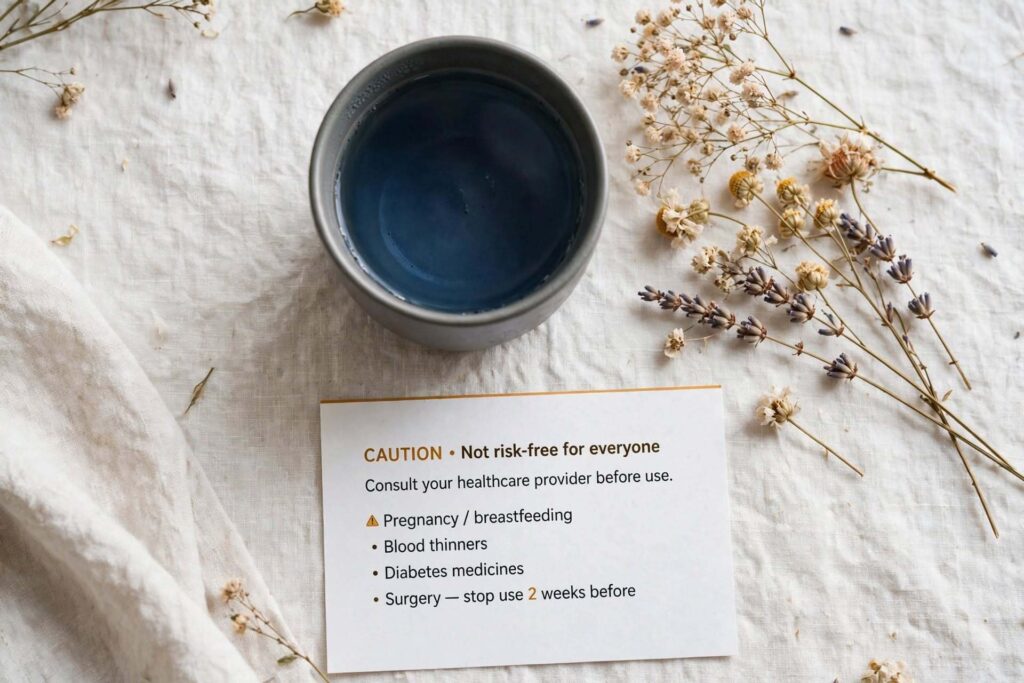
Butterfly pea flower tea has a long history as a food colour and herbal drink in Southeast Asia and India, and no serious problems have been reported at normal amounts. Long-term human safety data are limited, though, and a few cautions are sensible.
- Pregnancy and breastfeeding: avoid it. The plant contains cyclotides, and lab research has reported uterus-stimulating activity in plant parts. The flower tea hasn’t been studied in pregnancy, so there’s no basis to call it safe.
- Blood thinners and antiplatelet drugs (warfarin, clopidogrel, daily aspirin): talk to your doctor. Earlier lab work reported anti-platelet activity, so there’s a theoretical risk of added bleeding. It isn’t proven in people, and it’s the kind of interaction you’d want to be wrong about in advance.
- Diabetes medicines or insulin: the extract might add to the glucose-lowering effect. It probably won’t cause a dramatic drop, but monitor your blood sugar and let your doctor know.
- Low blood pressure: start with one cup and see how you feel.
- Before surgery or dental procedures: it’s common advice to stop herbal products a couple of weeks beforehand, and sensible to tell your surgeon. There’s no specific study on butterfly pea flower here.
- Allergies or an upset stomach: stop if you get a rash, itching or digestive trouble.
- Children: there’s no research, so skip it.
For a broader look at using herbs without getting burned, see our supplement safety articles, and our guide to shatavari and adaptogens for another example.
How to make butterfly pea flower tea properly
The usual recipe for butterfly pea flower tea has a contradiction in it: it tells you to simmer the flowers for 5 to 10 minutes and then warns that the antioxidants can’t take heat. Anthocyanins do degrade with prolonged heat, so a gentle steep beats a long boil.
- Put 5 to 10 dried flowers (about 1 to 2 grams) in a cup.
- Pour over about 200 to 250 ml of hot, not furiously boiling, water.
- Cover and steep for 5 to 10 minutes.
- Strain, and add lemon if you like, which turns it purple and brightens the flavour. A little acid also keeps anthocyanins more stable.
- Skip the sugar. It defeats the purpose.
When to drink butterfly pea flower tea. If blood sugar is your reason, drink it with a meal or just before, because that’s the situation the trial tested. Many people just enjoy it as a caffeine-free evening drink. One to two cups a day is a reasonable limit, mostly because that’s what people have drunk traditionally and there’s no evidence that more helps.
Storage. Keep dried flowers in an airtight container, away from heat, light and damp. The pigments fade in sunlight.
Sourcing. If you pick flowers from a roadside wall, you don’t know what pollution or pesticides they’ve been exposed to. Grow your own or buy from a reputable supplier, and rinse fresh flowers before drying them in the shade.
The money maths on butterfly pea flower tea
A café cup of blue tea can cost several hundred rupees. Dried flowers cost a small fraction of that per cup, and a plant on your balcony costs next to nothing. Here’s the formula I use for any wellness drink: divide the price of the pack by the number of cups you get, then compare that to what you’d pay in a café. If a cup costs ₹300 and does nothing the home version can’t, you’re paying for the cup, the chair and the Instagram photo, not the flower.
The three complaints in the usual story, and what helps more
Videos on this subject often open with someone who is sleepy at 2 p.m., worried about dull skin and told they’re prediabetic, and blame all three on blood sugar spikes. There’s some truth in the idea that big swings can make you feel tired. But the mid-afternoon dip is also a normal part of the body’s daily rhythm, and it happens even if you skip lunch, so sleep debt and timing matter too.
| Problem | What has stronger evidence than a tea |
|---|---|
| Afternoon slump | Enough sleep, morning daylight, a protein and fibre-rich lunch, a 10-minute walk after eating |
| Prediabetes | Weight loss if you carry extra, regular exercise including strength training, fewer sugary drinks and refined carbs, repeat HbA1c checks |
| Dull skin | Daily sunscreen, sleep, not smoking, enough protein and fruit and vegetables |
Our guides to sleep hygiene, light hygiene and circadian health, circadian fasting and low-friction prevention cover those.
When to see a doctor instead of relying on butterfly pea flower tea
Please don’t rely on a tea if you notice:
- Increased thirst, frequent urination or unexplained weight loss
- Blurred vision, slow-healing sores or constant tiredness
- A prediabetes or diabetes diagnosis you haven’t followed up
- Blood sugar that keeps climbing despite changes
- Dizziness, shakiness or sweating if you take diabetes medicine
- Bruising or bleeding more than usual if you take blood thinners
- Any thought of stopping medicine because you’re drinking a herbal tea (never do this without medical advice)
If you’ve been searching symptoms online first, our article on AI self-diagnosis and digital health explains how to use that without letting it make the call.
Where to go next
- Blood sugar and metabolism: Blood sugar, Insulin resistance, CGM for non-diabetics, Habits to quit for better health
- Sleep and energy: Sleep hygiene, Light hygiene, Circadian fasting
- Herbs and supplements: Supplement safety, Shatavari and adaptogens, Mushroom coffee, Nootropics
- Skin and nutrition: Functional protein and collagen, Sex-specific nutrition for women
- Habits that stick: Low-friction prevention
- More guides: Nutrition & Diet, Health & Wellness
Questions people ask about butterfly pea flower tea
What is butterfly pea flower tea?
It’s a caffeine-free herbal infusion made from the dried flowers of Clitoria ternatea, known in India as aparajita. It’s naturally deep blue from anthocyanin pigments and turns purple or pink when you add lemon or another acid.
Does butterfly pea flower tea lower blood sugar?
Possibly a little, after a meal. One small randomised trial in 15 healthy men found that a butterfly pea extract taken with 50 g of sucrose lowered blood glucose and insulin at 30 minutes compared with sucrose alone. It’s a tiny study, and it used an extract, not a brewed tea. It isn’t a treatment for diabetes.
Is butterfly pea flower tea safe for diabetics?
It has a long history as a drink, and the extract didn’t change fasting glucose in healthy men. But no trial has tested it in people taking diabetes medicines, so it might add to their effect. Monitor your blood sugar and tell your doctor.
Can butterfly pea flower tea help you lose weight?
There’s no human trial showing it does. The idea rests on a theory that lowering the blood sugar rise lowers insulin and fat storage, which hasn’t been tested for weight loss.
Is butterfly pea flower tea good for skin?
Lab studies on skin cells in a dish found that a water extract reduced UV and peroxide damage. Nobody has shown that drinking the tea improves wrinkles, glow or sun protection in people. Sunscreen has far better evidence.
When is the best time to drink butterfly pea flower tea?
With a meal or shortly before, if blood sugar is your goal, since that’s the situation studied. Otherwise any time is fine, but avoid very large amounts and avoid it late if you find you’re sensitive to it.
How do you make butterfly pea flower tea?
Steep 5 to 10 dried flowers (about 1 to 2 g) in 200 to 250 ml of hot water for 5 to 10 minutes, covered, then strain. Add lemon if you like. A gentle steep protects the pigments better than a long boil.
Who should avoid butterfly pea flower tea?
Pregnant and breastfeeding women, children, and anyone on blood thinners or antiplatelet drugs unless their doctor agrees. People on diabetes medicine should monitor their blood sugar, and anyone due for surgery should tell their surgeon.
Does butterfly pea flower tea have to turn purple to be real?
Real butterfly pea flower tea does change colour with acid, but so do other anthocyanin-rich plants. The colour change shows the blue comes from a natural pH-sensitive pigment, not that the product is pure butterfly pea.
How many cups of butterfly pea flower tea can I drink a day?
One to two cups is a reasonable amount, in line with traditional use. There’s no research showing more is better, and long-term safety data are limited.
The short version
Butterfly pea flower tea is a pleasant, caffeine-free, naturally blue drink with a real but very small piece of human evidence: in one study of 15 healthy men, an extract taken with sugar blunted the post-drink rise in glucose and insulin. The weight-loss and skin claims rest on theory and lab dishes, and the safety cautions about pregnancy, blood thinners and diabetes medicine are worth taking seriously.
If you like butterfly pea flower tea, drink it, with a meal and without sugar, and keep your expectations at a cup of tea, not a treatment. If you’re worried about your blood sugar, the best move is a doctor’s visit, a repeat HbA1c and a walk after dinner.
Disclaimer: this article is general education, not medical advice. Always consult a qualified healthcare professional before using herbal products, especially if you are pregnant, take medication or have a medical condition. See our full disclaimer.
Research referenced: Chusak et al., 2018, BMC Complementary and Alternative Medicine, acute effect of Clitoria ternatea flower beverage on glycemic response and antioxidant capacity in healthy subjects; Zakaria et al., 2018, Phytotherapy Research, protective effects of an aqueous extract of Clitoria ternatea flower in human keratinocytes and the related poster abstract on extract types; the 2025 literature review of butterfly pea flower antioxidants and glycemic response; and the 2026 clinical study of Clitoria ternatea tea in type 2 diabetes with diabetic distress.




Leave a Reply